Antarctica

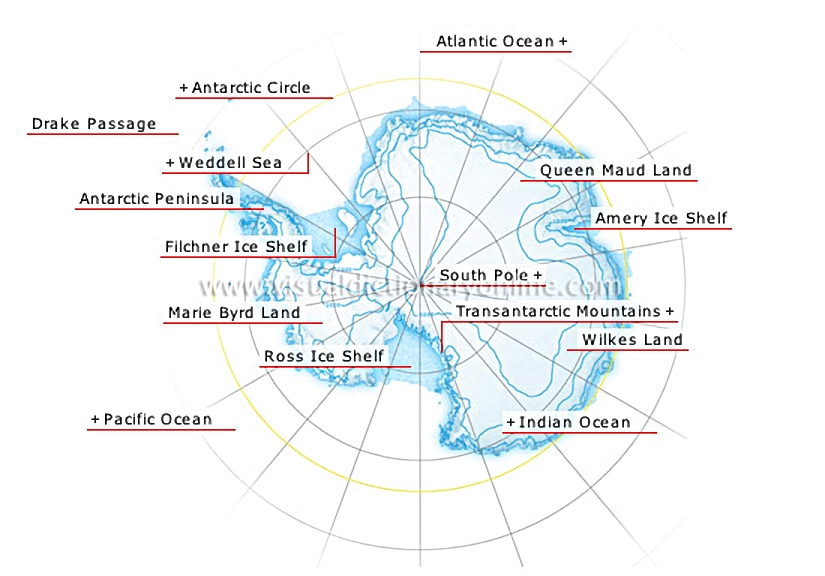
The only uninhabited continent (5 million mi2), located inside the south polar circle; 98% of its surface is covered with an ice cap. Antarctica holds 90% of the Earth’s freshwater reserves.
Antarctica 						Mountain chain that is an extension of the Andes Cordillera in South America; its peaks reach heights of more than 13,000 feet.												Immense ice shelf beginning at the edge of the continent’s southern slope.				  							Region at an altitude of over 6,500 feet.				  							Fed by adjacent continental ice sheets and by local precipitation; it borders the Weddell Sea.				  							Extends far beyond the polar circle and includes several mountain systems; parts that crumble away from its tip form small islands.				  							Almost 560 mi wide, it separates Tierra del Fuego from Antarctica and connects the Atlantic to the Pacific; its currents are very powerful.				  							Parallel of latitude at 66°34' S that marks the polar zone, where days and nights last 24 hours during solstices.												From the polar circle to the continent, this ocean is called the Antarctic.												Region of the Antarctic continent that takes its name from a 19th-century American mariner and explorer.				  							Its immense size makes it one of the world’s most remarkable ice shelves.				  							Oldest and largest part of Antarctica, Queen Maud Land also forms its continental shelf.				  							Point of the terrestrial surface at the southern extremity of the Earth’s axis of rotation; the Norwegian Amundsen and his expedition first reached it in 1911.												From the polar circle to the continent, this ocean is called the Antarctic.												Sea northwest of Antarctica, partly delimited by the Antarctic Peninsula; more than half of its surface is covered with pack ice.												The world’s largest ocean (69 million mi2), the Pacific covers 30% of the Earth’s surface, more than all of the continents put together.
See Also


mountain

grid system

Earth coordinate system

planisphere

ocean trenches and ridges

hydrologic cycle

examples of shorelines

common coastal features

ocean floor

Transantarctic Mountains

Mountain chain that is an extension of the Andes Cordillera in South America; its peaks reach heights of more than 13,000 feet.
mountain
mountain

Ross Ice Shelf

Immense ice shelf beginning at the edge of the continent’s southern slope.

Marie Byrd Land

Region at an altitude of over 6,500 feet.

Filchner Ice Shelf

Fed by adjacent continental ice sheets and by local precipitation; it borders the Weddell Sea.

Antarctic Peninsula

Extends far beyond the polar circle and includes several mountain systems; parts that crumble away from its tip form small islands.

Drake Passage

Almost 560 mi wide, it separates Tierra del Fuego from Antarctica and connects the Atlantic to the Pacific; its currents are very powerful.

Antarctic Circle

Parallel of latitude at 66°34' S that marks the polar zone, where days and nights last 24 hours during solstices.
grid system
grid system
Earth coordinate system

Indian Ocean

From the polar circle to the continent, this ocean is called the Antarctic.
planisphere
planisphere
ocean trenches and ridges
hydrologic cycle
hydrologic cycle
examples of shorelines
common coastal features
ocean floor
ocean floor

Wilkes Land

Region of the Antarctic continent that takes its name from a 19th-century American mariner and explorer.

Amery Ice Shelf

Its immense size makes it one of the world’s most remarkable ice shelves.

Queen Maud Land

Oldest and largest part of Antarctica, Queen Maud Land also forms its continental shelf.

South Pole

Point of the terrestrial surface at the southern extremity of the Earth’s axis of rotation; the Norwegian Amundsen and his expedition first reached it in 1911.
Earth coordinate system

Atlantic Ocean

From the polar circle to the continent, this ocean is called the Antarctic.
planisphere
planisphere
ocean trenches and ridges
hydrologic cycle
hydrologic cycle
examples of shorelines
common coastal features
ocean floor
ocean floor

Weddell Sea

Sea northwest of Antarctica, partly delimited by the Antarctic Peninsula; more than half of its surface is covered with pack ice.
common coastal features
examples of shorelines
ocean trenches and ridges

Pacific Ocean

The world’s largest ocean (69 million mi2), the Pacific covers 30% of the Earth’s surface, more than all of the continents put together.
ocean trenches and ridges
hydrologic cycle
hydrologic cycle
examples of shorelines
common coastal features
ocean floor
ocean floor
planisphere
planisphere