grid system

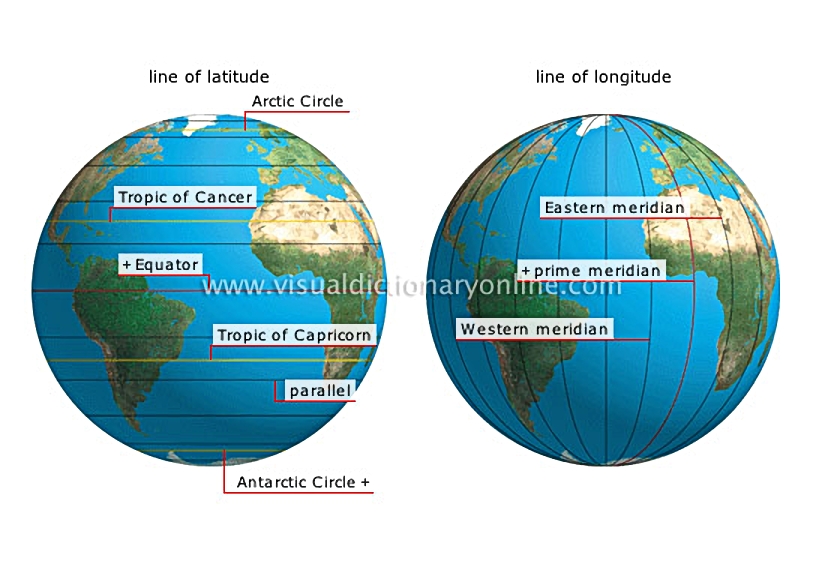
Collective term for the parallels and meridians that form an imaginary grid over the Earth’s surface, making it possible to locate a specific point.
grid system 						Coordinate of a point on the Earth’s surface indicating, in degrees, its distance from the prime meridian.				  							Imaginary line connecting the poles and perpendicular to the Equator; located west of the Greenwich meridian.				  							Chosen by convention as the meridian of origin; its longitude, 0, divides the Eastern and Western hemispheres.												Imaginary line connecting the poles and perpendicular to the Equator; located east of the Greenwich meridian.				  							Coordinate of a point on the Earth’s surface indicating, in degrees, its distance from the Equator.				  							Parallel of latitude 66°34' N; it marks the polar zone, where days and nights last 24 hours during solstices.				  							Imaginary line encircling the Earth at its greatest circumference and perpendicular to the polar axis; its latitude, 0, serves as a reference point for calculating other latitudes.												Parallel located at 23°26' N latitude (a distance of about 1,600 mi from the Equator).				  							Imaginary circle whose plane is parallel to the Equator.				  							Parallel located at 23°26' N latitude (a distance of about 1,600 mi from the Equator).				  							Parallel of latitude at 66°34' S; it marks the polar zone, where days and nights last 24 hours during solstices.
See Also


hemispheres

Antarctica

Earth coordinate system

line of longitude

Coordinate of a point on the Earth’s surface indicating, in degrees, its distance from the prime meridian.

Western meridian

Imaginary line connecting the poles and perpendicular to the Equator; located west of the Greenwich meridian.

prime meridian

Chosen by convention as the meridian of origin; its longitude, 0, divides the Eastern and Western hemispheres.
hemispheres
hemispheres

Eastern meridian

Imaginary line connecting the poles and perpendicular to the Equator; located east of the Greenwich meridian.

line of latitude

Coordinate of a point on the Earth’s surface indicating, in degrees, its distance from the Equator.

Arctic Circle

Parallel of latitude 66°34' N; it marks the polar zone, where days and nights last 24 hours during solstices.

Equator

Imaginary line encircling the Earth at its greatest circumference and perpendicular to the polar axis; its latitude, 0, serves as a reference point for calculating other latitudes.
hemispheres
hemispheres

Tropic of Capricorn

Parallel located at 23°26' N latitude (a distance of about 1,600 mi from the Equator).

parallel

Imaginary circle whose plane is parallel to the Equator.

Tropic of Cancer

Parallel located at 23°26' N latitude (a distance of about 1,600 mi from the Equator).

Antarctic Circle

Parallel of latitude at 66°34' S; it marks the polar zone, where days and nights last 24 hours during solstices.
Antarctica
Antarctica