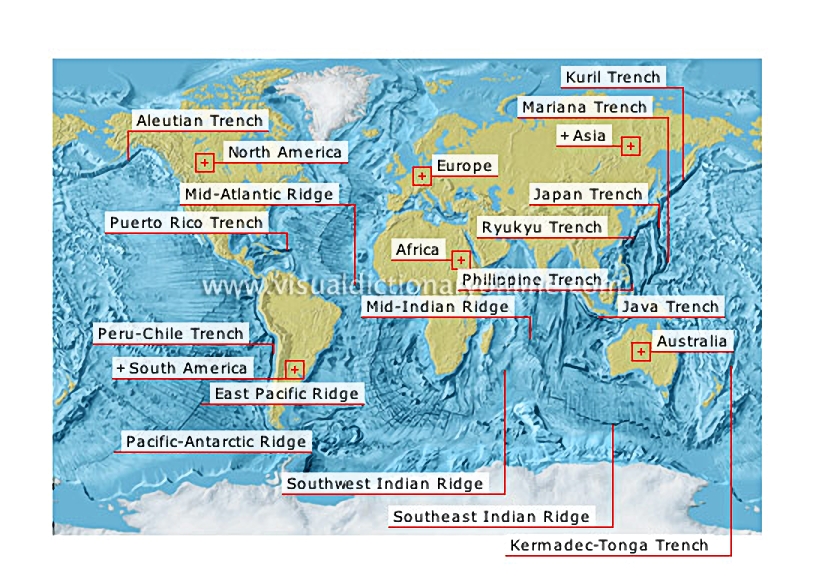
ocean trenches and ridges
Trench: very deep, elongated cavity bordering a continent or an island arc; it forms when one tectonic plate slides beneath another. Ridge: underwater mountain range that criss-crosses the oceans and is formed by rising magma in a zone where two plates are moving apart.
Mid-Indian Ridge
Mountain range in the middle of the Indian Ocean that separates the African and Australian-Indian plates.
Southwest Indian Ridge
Ridge separating the African and Antarctic plates; it joins the Mid-Indian and Southeast Indian ridges off the coast of Madagascar.
South America
Represents about 12% of the world’s land and is linked to North America by Central America; its features include the Andes in the west and plains and plateaus in east and central regions.
Puerto Rico Trench
Trench located off the coast of Puerto Rico, on the boundary between the South American and Caribbean plates; it features the deepest point in the Atlantic Ocean (27,493 feet).
Peru-Chile Trench
Trench (26,460 feet) bordering South America; the world’s longest trench (3,700 mi), it is located on the boundary between the Nazca Plate and the South American Plate.
Pacific-Antarctic Ridge
Mountain range separating the Pacific and Antarctic plates; it joins the eastern Pacific Ridge off the coast of South America.
East Pacific Ridge
Ridge that marks the boundary between the Pacific and Cocos Islands plates to the north, and the Pacific and Nazca plates to the south.
Aleutian Trench
Trench (25,600 feet) extending from Alaska to the Kamchatka Peninsula; it results from the Pacific Plate sliding beneath the North American Plate.
North America
Its area (9.3 million mi2) represents about 16% of the world’s land; the Central American isthmus is an extension of North America.
Africa
Continent that represents about 20% of the world’s land; two-thirds of its surface lies north of the Equator. Characterized by very hot climates, Mediterranean in the north and south, tropical and arid elsewhere.
Mid-Atlantic Ridge
Ridge about 7,000 mi long, located in the middle of the Atlantic Ocean; some of its mountains reach the surface, forming islands such as Iceland.
Europe
Western extremity of the vast Eurasian continent that, by convention, is separated from Asia by the Ural Mountains; it covers a relatively small area.
Asia
The largest and most populous continent, Asia represents 32% of the world’s land; it is dominated by imposing mountain ranges.
Ryukyu Trench
Trench (24,629 feet) located near the Ryukyu Islands; it marks the boundary between the Philippine Plate and the Eurasian Plate.
Japan Trench
Trench (27,929 feet) located east of Japan, on the boundary between the Pacific Plate and the Eurasian Plate; this zone is marked by intense seismic activity.
Kuril Trench
Trench (34,587 feet) located northeast of Japan; it results from the Pacific Plate sliding beneath the Eurasian Plate.
Mariana Trench
Cavity located near the Mariana Islands, where the Pacific Plate and the Philippine Plate converge; it is the world’s deepest trench (about 36,000 feet).
Philippine Trench
Trench bordering the eastern Philippines, reaching depths of 34,578 feet; it results from the Philippine Plate sinking beneath the Eurasian Plate.
Kermadec-Tonga Trench
Cavity located north of New Zealand, where the Pacific Plate meets the Australian-Indian Plate; it reaches depths of 35,702 feet.
Australia
The world’s largest island (3 million mi2) is sparsely inhabited in spite of its size; because of its isolation, Australia’s wildlife is unique.
Southeast Indian Ridge
Ridge separating the Antarctic Plate from the Australian-Indian Plate; its topography is more regular than the topography of the Southwest Indian and Mid-Indian ridges.
Java Trench
Trench located south of Indonesia, between the Australian-Indian and the Eurasian Plates; it is the deepest point in the Indian Ocean (24,440 ft).
 previous


