Earth coordinate system

The intersection of two imaginary lines, longitude and latitude, makes it possible to locate a precise point on the Earth’s surface.
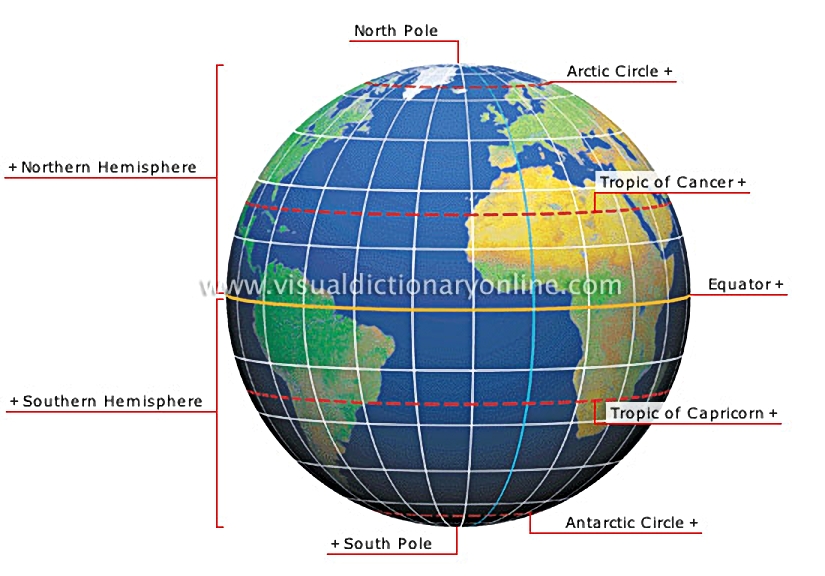
Earth coordinate system 						Parallel of latitude 66°34' N; it marks the polar zone, where days and nights last 24 hours during solstices.												Parallel located at 23°26' N latitude (a distance of about 1,600 mi from the Equator).												Imaginary line encircling the Earth at its greatest circumference and perpendicular to the polar axis; its latitude, 0, serves as a reference point for calculating other latitudes.												Parallel located at 23°26' N latitude (a distance of about 1,600 mi from the Equator).												Point on the Earth’s surface at the southern extremity of the axis of rotation, where the meridians converge.												Southern half of the globe in relation to the Equator.												Northern half of the globe in relation to the Equator.												Point on the Earth’s surface at the northern extremity of the axis of rotation, where the meridians converge.				  							Parallel of latitude at 66°34' S; it marks the polar zone, where days and nights last 24 hours during solstices.
See Also


line of latitude

hemispheres

grid system

Antarctica

Southern Hemisphere

Northern Hemisphere

magnetic compass

Arctic Circle

Parallel of latitude 66°34' N; it marks the polar zone, where days and nights last 24 hours during solstices.
line of latitude
line of latitude

Tropic of Cancer

Parallel located at 23°26' N latitude (a distance of about 1,600 mi from the Equator).
line of latitude
line of latitude

Equator

Imaginary line encircling the Earth at its greatest circumference and perpendicular to the polar axis; its latitude, 0, serves as a reference point for calculating other latitudes.
hemispheres
hemispheres
grid system
grid system

Tropic of Capricorn

Parallel located at 23°26' N latitude (a distance of about 1,600 mi from the Equator).
line of latitude
line of latitude

South Pole

Point on the Earth’s surface at the southern extremity of the axis of rotation, where the meridians converge.
Antarctica
Antarctica

Southern Hemisphere

Southern half of the globe in relation to the Equator.
Southern Hemisphere
Southern Hemisphere

Northern Hemisphere

Northern half of the globe in relation to the Equator.
Northern Hemisphere
Northern Hemisphere

North Pole

Point on the Earth’s surface at the northern extremity of the axis of rotation, where the meridians converge.

Antarctic Circle

Parallel of latitude at 66°34' S; it marks the polar zone, where days and nights last 24 hours during solstices.
Antarctica
Antarctica
line of latitude
line of latitude