hydrologic cycle

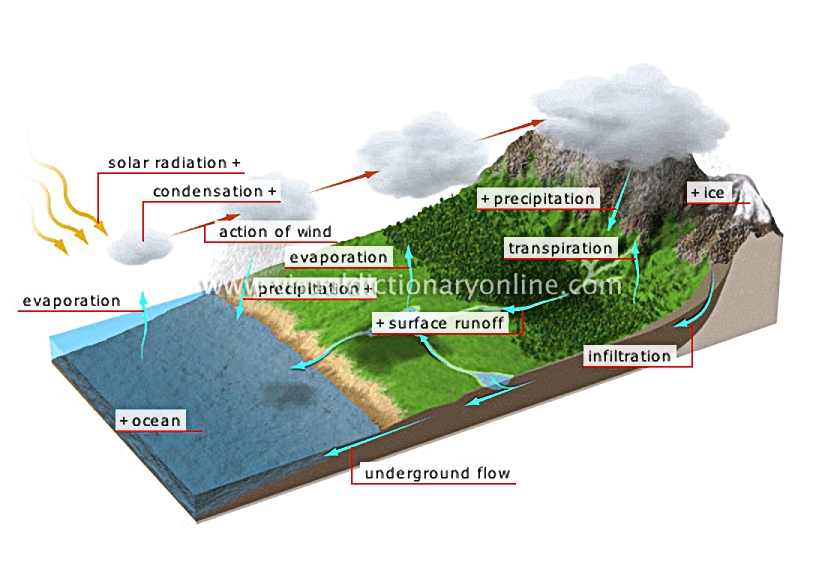
Continuous circulation of water in its different states (liquid, solid and gaseous) between the oceans, the atmosphere and the Earth’s surface.
hydrologic cycle 						It provides the heat necessary for water to evaporate.												The process by which water vapor is converted, by means of cooling, into liquid or solid water in the form of clouds.												Driven by winds, clouds fly over the land.				  							Water that accumulates high in the mountains in solid form.												Movement of infiltrated water that joins a watercourse on the surface or flows directly into lakes or the ocean.				  							Vast body of saltwater covering a large part of the Earth’s surface and separating the continents.												Various forms of water that fall from the atmosphere.				  							Conversion, without boiling, of liquid water into water vapor when exposed to heat.				  							Phenomenon by which plants discharge water vapor into the atmosphere.				  							Water penetrating into the soil through permeable rock.				  							Flow of rainwater or melting snow on the surface of the ground; it produces watercourses.												Conversion, without boiling, of liquid water into water vapor when exposed to heat.				  							Various forms of water that fall from the atmosphere.
See Also


structure of the Sun?[1]

wave

states of matter

clouds?[1]

snow crystals

mountain

glacier

planisphere

ocean trenches and ridges

ocean floor

watercourse

acid rain

solar radiation

It provides the heat necessary for water to evaporate.
structure of the Sun [1]
wave
wave

condensation

The process by which water vapor is converted, by means of cooling, into liquid or solid water in the form of clouds.
states of matter
states of matter
clouds [1]
clouds [1]

action of wind

Driven by winds, clouds fly over the land.

ice

Water that accumulates high in the mountains in solid form.
snow crystals
snow crystals
mountain
mountain
glacier
glacier

underground flow

Movement of infiltrated water that joins a watercourse on the surface or flows directly into lakes or the ocean.

ocean

Vast body of saltwater covering a large part of the Earth’s surface and separating the continents.
planisphere
planisphere
ocean trenches and ridges
ocean floor
ocean floor

precipitation

Various forms of water that fall from the atmosphere.

evaporation

Conversion, without boiling, of liquid water into water vapor when exposed to heat.

transpiration

Phenomenon by which plants discharge water vapor into the atmosphere.

infiltration

Water penetrating into the soil through permeable rock.

surface runoff

Flow of rainwater or melting snow on the surface of the ground; it produces watercourses.
watercourse
watercourse

evaporation

Conversion, without boiling, of liquid water into water vapor when exposed to heat.

precipitation

Various forms of water that fall from the atmosphere.