natural greenhouse effect

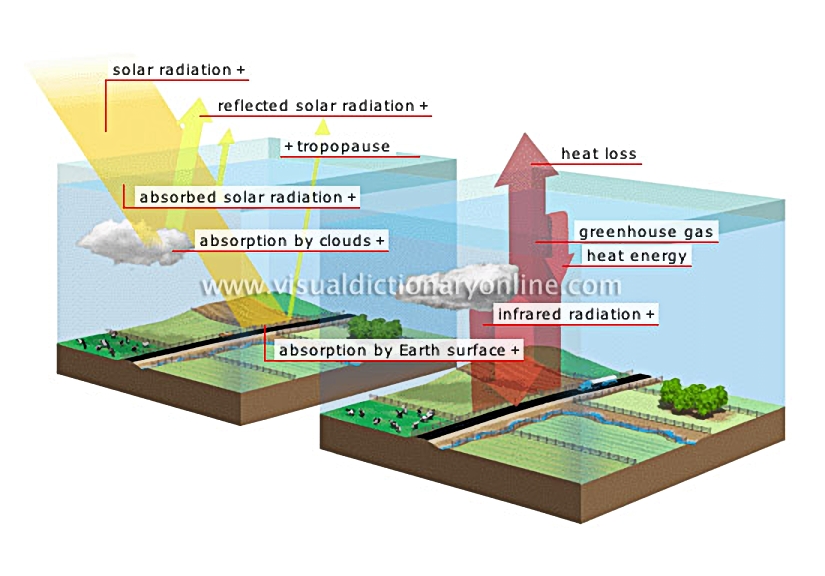
The greenhouse effect is an indispensable natural phenomenon; without it, the average temperature, currently 59°F, would be no higher than 0°F.
natural greenhouse effect 						Thirty percent of solar radiation is sent back into space by clouds, by particles suspended in the atmosphere and by the Earth’s surface.												Boundary between the troposphere, where meteorological phenomena are produced, and the stratosphere, which absorbs a large part of solar radiation.												Part of the infrared rays reflected by the Earth’s surface is not absorbed and dissipates in space.				  							Gas that traps heat in the atmosphere; composed mainly (60%) of carbon dioxide (CO2), methane (15%) and CFCs (12%).				  							Infrared radiation carries heat energy, which increases the temperature of the atmosphere.				  							The Earth’s surface reflects infrared radiation, part of which is retained in the atmosphere by greenhouse gases and clouds.												About 50% of solar radiation is absorbed by the Earth’s surface.												About 25% of solar radiation is absorbed by clouds.												A portion of solar radiation is converted into thermal energy by gaseous constituents in the atmosphere, in the clouds and on the Earth’s surface.												All the electromagnetic waves emitted by the Sun.

See Also


structure of the Sun?[1]

wave

profile of the Earths atmosphere

electromagnetic spectrum

soil profile

clouds?[1]

enhanced greenhouse effect

reflected solar radiation

Thirty percent of solar radiation is sent back into space by clouds, by particles suspended in the atmosphere and by the Earth’s surface.
structure of the Sun [1]
wave
wave

tropopause

Boundary between the troposphere, where meteorological phenomena are produced, and the stratosphere, which absorbs a large part of solar radiation.
profile of the Earth’s atmosphere

heat loss

Part of the infrared rays reflected by the Earth’s surface is not absorbed and dissipates in space.

greenhouse gas

Gas that traps heat in the atmosphere; composed mainly (60%) of carbon dioxide (CO2), methane (15%) and CFCs (12%).

heat energy

Infrared radiation carries heat energy, which increases the temperature of the atmosphere.

infrared radiation

The Earth’s surface reflects infrared radiation, part of which is retained in the atmosphere by greenhouse gases and clouds.
electromagnetic spectrum

absorption by Earth surface

About 50% of solar radiation is absorbed by the Earth’s surface.
soil profile
soil profile

absorption by clouds

About 25% of solar radiation is absorbed by clouds.
clouds [1]
clouds [1]

absorbed solar radiation

A portion of solar radiation is converted into thermal energy by gaseous constituents in the atmosphere, in the clouds and on the Earth’s surface.
structure of the Sun [1]
wave
wave

solar radiation

All the electromagnetic waves emitted by the Sun.
structure of the Sun [1]
wave
wave