HOME
::
ENERGY
::
HYDROELECTRICITY
::
ELECTRICITY TRANSMISSION
::
PYLON
pylon
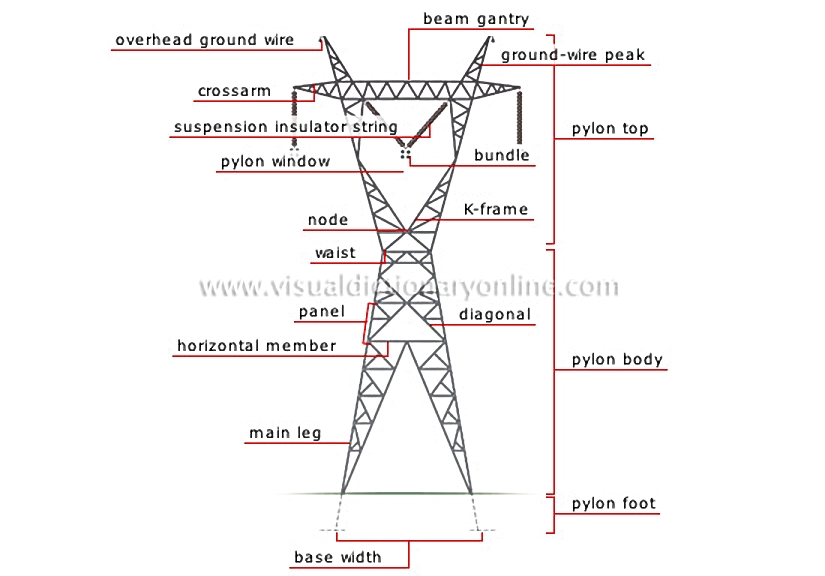
Metal beam that supports the electric conductors along the overhead transportation lines.
previous
next
See Also
production of electricity from wind energy
production of electricity from solar energy
production of electricity from geothermal energy
production of electricity from thermal energy
production of electricity from nuclear energy
steps in production of electricity
crossarm
Horizontal element that protrudes on each side of the pylon; it supports the bundles by means of suspension insulator strings.
suspension insulator string
Insulators that are assembled in a vertical or oblique chain; the overhead line conductors hang from it.
bundle
Conductor cables that are kept a constant distance apart by spacers; they are used to transport current.
K-frame
Part of the pylon that rests on the waist; it has two branches that end at the beam gantry.
node
Point at which several legs and bars come together.
panel
Part of the pylon between two horizontal members.
horizontal member
Horizontal bar that connects the main legs to strengthen them.
main leg
The main tower legs of the pylon body; they support mainly vertical weights.
base width
Space between the foundation axes of the main legs.
pylon foot
Lower part of the pylon that is usually underground; the legs are anchored to it.
pylon body
Part of the pylon support between the top and the foot.
diagonal
Diagonal bar that connects two main legs or a horizontal member and a main leg.
waist
Demarcation bar between the pylon top and body that is held tightly between them.
pylon window
Space bounded by the inner side of the arms of the K-frame and the beam gantry.
pylon top
Upper portion of the pylon where the insulator strings and bundles are attached.
ground-wire peak
Projection atop the pylon that supports the overhead ground wire.
overhead ground wire
Conductor that is connected to the ground and attached above the bundles of the overhead lines to protect them from lightning.
beam gantry
Horizontal element of the pylon top; it supports the bundles inside the pylon window.

 previous


