HOME
::
ENERGY
::
WIND ENERGY
::
WIND TURBINES AND ELECTRICITY PRODUCTION
::
PRODUCTION OF ELECTRICITY FROM WIND ENERGY
production of electricity from wind energy
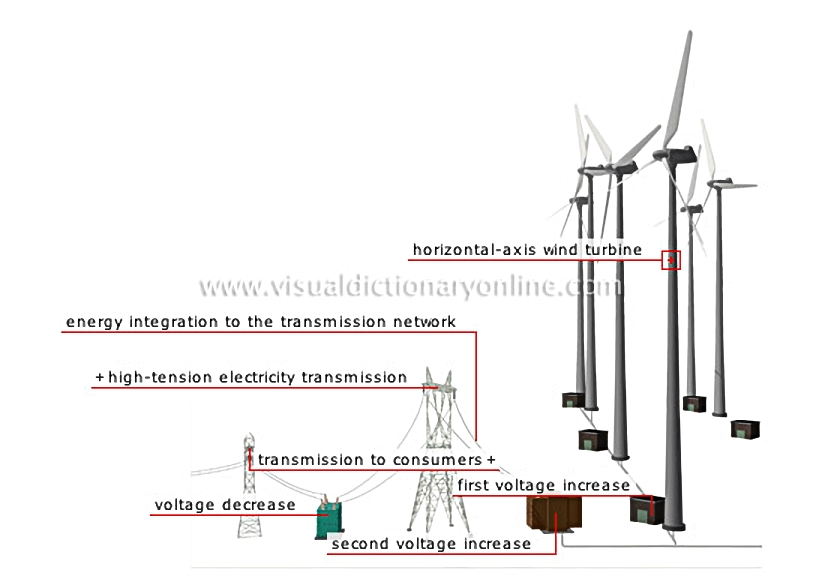
Wind farms contain a group of wind turbines, which are driven by the wind; they produce electricity and carry it along the transmission and distribution networks to which they are connected.
previous
next
See Also
network connection
overhead connection
horizontal-axis wind turbine
vertical-axis wind turbine
transmission to consumers
The electricity is carried to areas of consumption by low-voltage distribution lines.
network connection
overhead connection
voltage decrease
Before integrating the electricity into the home network, the voltage is progressively decreased to 240 V.
high-tension electricity transmission
Using high-voltage lines to transmit electricity over long distances reduces the strength of the current and, as a result, energy losses.
energy integration to the transmission network
The electricity produced is integrated into the network.
second voltage increase
first voltage increase
Increase in voltage: transformers carry high-voltage electricity produced by the alternator to reduce loss during transport.
horizontal-axis wind turbine
The most common type of wind turbine whose axis is parallel to the direction of the wind.
horizontal-axis wind turbine

 previous


