overhead connection

The equipment and overhead conductors that connect a subscriber’s electric system to the public distribution network.
overhead connection 						Slanted part that connects the pole to the crossarm to hold it in place horizontally.				  							Protection device for the electric circuit; it falls from the fuse holder to cut the current in the event of a surge.				  							Unit that consists of a fuse and a fuse holder.				  							Part on which low-tension distribution line conductors are joined to the transformers.				  							Device that alters electric voltage; voltage is decreased before being distributed by low-tension lines to areas of consumption.				  							Piece of nonconducting material that connects the distribution line conductors to the support.				  							Place where the customer’s service entrance is connected to the low-tension distribution line.				  							Overhead line that distributes electricity up to a voltage of 750 V; its conductors are located under the transformer.				  							Insulator and point where the current enters the medium-tension transformer.				  							Electric junction point where the fuse is attached and on which it articulates so the fuse can fall over.				  							Device that protects the electric facilities from power surges caused by lightning.				  							Horizontal element located at the top of an electricity pole; insulators are attached to it.				  							Overhead line that distributes electricity at a voltage between 750 and 50,000 V; its conductors are located at the top of electricity poles.				  							Linking piece with a bolt, which is tightened to bring together two conductors to establish an electric connection between them.				  							Piece of nonconducting material that connects the distribution line conductors to the support.

See Also


network connection

brace

Slanted part that connects the pole to the crossarm to hold it in place horizontally.

fuse

Protection device for the electric circuit; it falls from the fuse holder to cut the current in the event of a surge.

fuse cutout

Unit that consists of a fuse and a fuse holder.

terminal

Part on which low-tension distribution line conductors are joined to the transformers.

transformer

Device that alters electric voltage; voltage is decreased before being distributed by low-tension lines to areas of consumption.

insulator

Piece of nonconducting material that connects the distribution line conductors to the support.
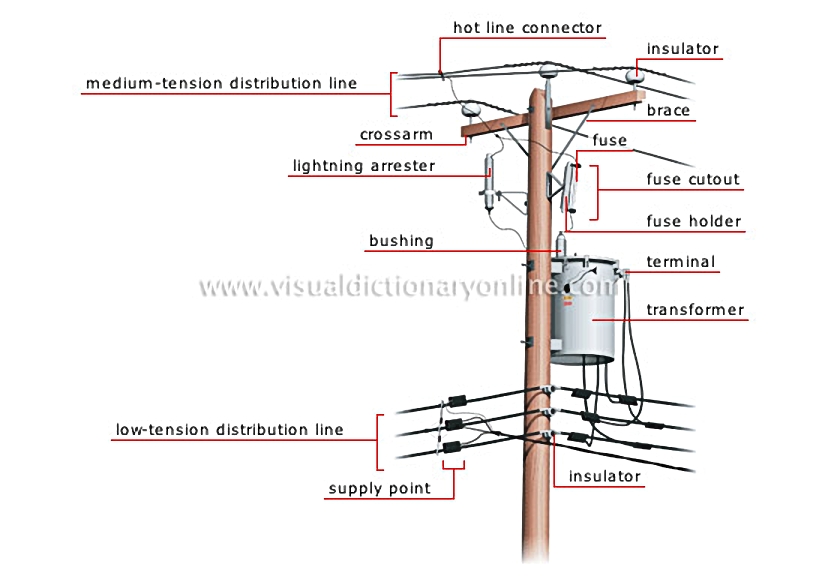
supply point

Place where the customer’s service entrance is connected to the low-tension distribution line.

low-tension distribution line

Overhead line that distributes electricity up to a voltage of 750 V; its conductors are located under the transformer.

bushing

Insulator and point where the current enters the medium-tension transformer.

fuse holder

Electric junction point where the fuse is attached and on which it articulates so the fuse can fall over.

lightning arrester

Device that protects the electric facilities from power surges caused by lightning.

crossarm

Horizontal element located at the top of an electricity pole; insulators are attached to it.

medium-tension distribution line

Overhead line that distributes electricity at a voltage between 750 and 50,000 V; its conductors are located at the top of electricity poles.

hot line connector

Linking piece with a bolt, which is tightened to bring together two conductors to establish an electric connection between them.

insulator

Piece of nonconducting material that connects the distribution line conductors to the support.