production of electricity from solar energy

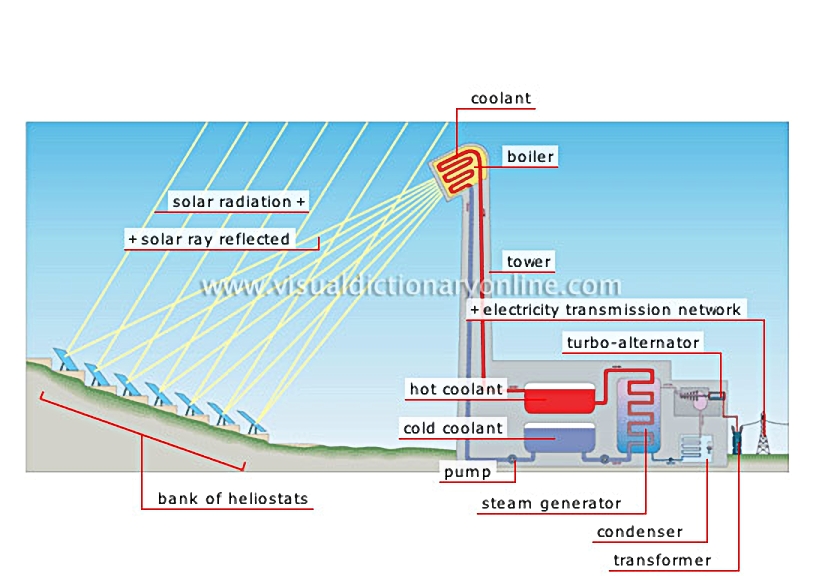
Heating the coolant directly with solar rays turns water into steam, which then turns the turbo-alternator to produce electricity.
production of electricity from solar energy 						Device that uses steam to convert the mechanical force generated by the rotation of the turbine into electricity.				  							Electricity is carried over vast distances by a network of cables that extends from the power plant to consumers.				  							Device used to alter the electric voltage; the voltage is increased at the plant outlet in order to carry the current over long distances.				  							Circuit that cools the steam from the turbine and condenses it into water, which is reintroduced into the steam generator.				  							Device that uses heat to convert water into steam to activate the turbo-alternator.				  							After releasing its heat to the steam generator, the cold coolant returns to the boiler.				  							The coolant extracts heat from the boiler and carries it to the steam generator and turbine.				  							Device that ensures that the cold coolant liquid flows to the boiler.				  							Heliostats: remote-controlled adjustable mirrors that follow the Sun’s trajectory and concentrate solar radiation toward the boiler at the top of the tower.				  							The Sun emits waves in the form of luminous radiation (41% visible light, 52% infrared light and 7% ultraviolet light).												Solar rays trapped by heliostats are sent to the boiler.												Fluid (e.g., a mixture of melted salts) that traps the heat from concentrated solar radiation and carries it to the turbine.				  							Structure atop which the boiler sits and collects luminous energy; it can reach 325 ft in height.				  							Enclosure in which the concentrated heat from the Sun’s rays raises the temperature of the coolant.
See Also


wave

structure of the Sun?[1]

solar furnace

turbo-alternator

Device that uses steam to convert the mechanical force generated by the rotation of the turbine into electricity.

electricity transmission network

Electricity is carried over vast distances by a network of cables that extends from the power plant to consumers.

transformer

Device used to alter the electric voltage; the voltage is increased at the plant outlet in order to carry the current over long distances.

condenser

Circuit that cools the steam from the turbine and condenses it into water, which is reintroduced into the steam generator.

steam generator

Device that uses heat to convert water into steam to activate the turbo-alternator.

cold coolant

After releasing its heat to the steam generator, the cold coolant returns to the boiler.

hot coolant

The coolant extracts heat from the boiler and carries it to the steam generator and turbine.

pump

Device that ensures that the cold coolant liquid flows to the boiler.

bank of heliostats

Heliostats: remote-controlled adjustable mirrors that follow the Sun’s trajectory and concentrate solar radiation toward the boiler at the top of the tower.

solar radiation

The Sun emits waves in the form of luminous radiation (41% visible light, 52% infrared light and 7% ultraviolet light).
wave
wave
structure of the Sun [1]

solar ray reflected

Solar rays trapped by heliostats are sent to the boiler.
wave
wave
structure of the Sun [1]

coolant

Fluid (e.g., a mixture of melted salts) that traps the heat from concentrated solar radiation and carries it to the turbine.

tower

Structure atop which the boiler sits and collects luminous energy; it can reach 325 ft in height.

boiler

Enclosure in which the concentrated heat from the Sun’s rays raises the temperature of the coolant.