tectonic plates

Immense portions of the lithosphere that slide over the asthenosphere; this shifting movement shapes the Earth’s topography.
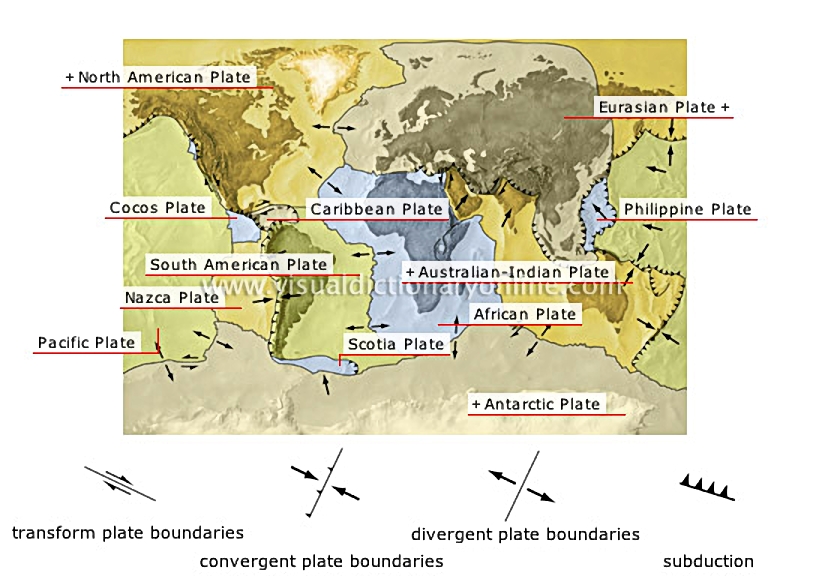
tectonic plates 						Plate along the coast of Mexico and Central America; it is sinking beneath the North American Plate and the Caribbean Plate.				  							Together with the Pacific Plate, this plate creates the San Andreas Fault (750 mi), which extends from the Gulf of California to San Francisco.												The largest plate; it is stationary.												Plate that is moving north 3 in per year; it forms the Red Sea by means of divergence from the African Plate.												Plate that forms the Philippines archipelago by means of subduction with the Eurasian Plate.				  							Plate converging with the Australian-Indian Plate; it created the Himalayas.												Plate that, diverging from the South American Plate, forms an underwater mountain chain.				  							Plate that forms the Andes cordillera by means of subduction with the Nazca Plate.				  							Small plate under which the Antarctic Plate and part of the South American Plate are sliding.				  							One of the most rapidly shifting plates, moving 3 in per year.				  							Plate subducting under the American plates; the Caribbean Plate created the islands of the Lesser Antilles.				  							The only entirely oceanic plate, it is also among the most rapidly shifting plates (4 in per year).				  							Plates that slide against each other, triggering earthquakes along faults of the same name.				  							Plates that collide, triggering either subduction or folding, which results in the creation of mountains.				  							Plates that are moving apart, causing magma to appear, which solidifies to generate a new crust.				  							Phenomenon by which an oceanic plate slides under a continental plate or under another oceanic plate, resulting in a trench.
See Also


North America

Antarctica

Asia

Oceania

Europe

earthquake

ocean trenches and ridges

structure of the Earth

Cocos Plate

Plate along the coast of Mexico and Central America; it is sinking beneath the North American Plate and the Caribbean Plate.

North American Plate

Together with the Pacific Plate, this plate creates the San Andreas Fault (750 mi), which extends from the Gulf of California to San Francisco.
North America
North America

Antarctic Plate

The largest plate; it is stationary.
Antarctica
Antarctica

Australian-Indian Plate

Plate that is moving north 3 in per year; it forms the Red Sea by means of divergence from the African Plate.
Asia
Asia
Oceania
Oceania

Philippine Plate

Plate that forms the Philippines archipelago by means of subduction with the Eurasian Plate.

Eurasian Plate

Plate converging with the Australian-Indian Plate; it created the Himalayas.
Asia
Asia
Europe
Europe

African Plate

Plate that, diverging from the South American Plate, forms an underwater mountain chain.

South American Plate

Plate that forms the Andes cordillera by means of subduction with the Nazca Plate.

Scotia Plate

Small plate under which the Antarctic Plate and part of the South American Plate are sliding.

Nazca Plate

One of the most rapidly shifting plates, moving 3 in per year.

Caribbean Plate

Plate subducting under the American plates; the Caribbean Plate created the islands of the Lesser Antilles.

Pacific Plate

The only entirely oceanic plate, it is also among the most rapidly shifting plates (4 in per year).

transform plate boundaries

Plates that slide against each other, triggering earthquakes along faults of the same name.

convergent plate boundaries

Plates that collide, triggering either subduction or folding, which results in the creation of mountains.

divergent plate boundaries

Plates that are moving apart, causing magma to appear, which solidifies to generate a new crust.

subduction

Phenomenon by which an oceanic plate slides under a continental plate or under another oceanic plate, resulting in a trench.