respiratory system

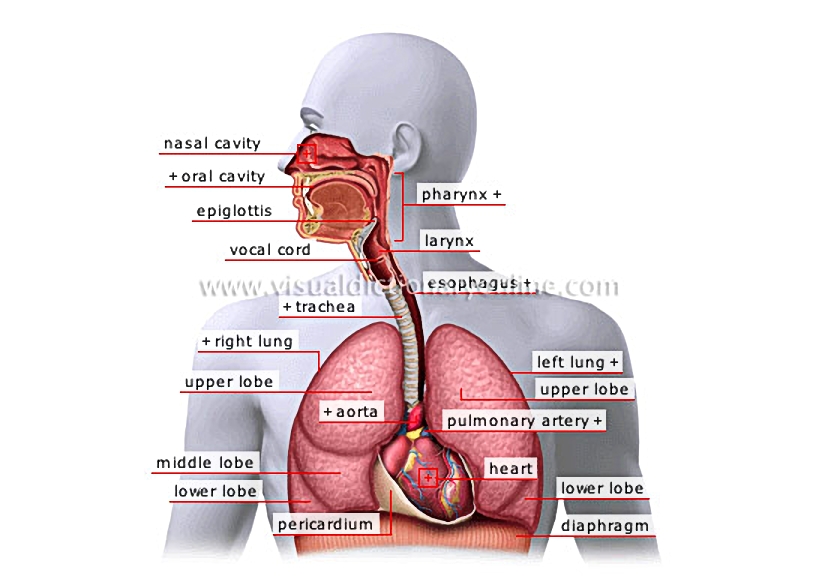
It causes gaseous exchanges to take place in the lungs by ensuring that oxygen is carried to the blood through inspiration, and carbon dioxide is eliminated from the blood through expiration.
respiratory system 						Movable cartilaginous plate ensuring that the larynx closes during ingestion of food so that food cannot enter the respiratory tract.				  							Muscular membranous channel connecting the nasal cavity to the larynx and the oral cavity to the esophagus; it enables breathing, ingestion of food and speech.												Muscular membranous channel of the anterior section of the digestive tract; it allows food to reach the stomach.												Muscular cartilaginous tract that is a continuation of the larynx; it divides into two main bronchi, each of which ends in a lung, and allows air to pass.												Respiratory organ divided into two lobes where blood from the pulmonary artery is cleansed of carbon dioxide and enriched with oxygen.												Artery carrying blood that is poor in oxygen and rich in carbon dioxide to the lungs; it is the only artery that transports oxygen-poor blood.												Section of the left lung separated from the lower lobe by the oblique fissure.				  							Main artery of the body that originates in the left ventricle of the heart and is made up of four segments; it distributes oxygenated blood throughout the body.												Section of the left lung separated from the upper lobe by the oblique fissure.				  							Main muscle of inspiration separating the thorax from the abdomen; its contraction increases the size of the thoracic cage and lungs, into which inhaled air is carried.				  							Muscular organ divided into four chambers; its regular rhythmic contractions cause blood to circulate throughout the organism.												Exterior casing of the heart formed of an inner layer adhering to the myocardium and a thick fibrous outer layer.				  							Section of the right lung separated from the middle and upper lobes by an oblique fissure.				  							Section of the right lung separated from the upper lobe by a horizontal fissure and from the lower lobe by an oblique fissure.				  							Section of the right lung separated from the middle lobe by a horizontal fissure and from the lower lobe by an oblique fissure.				  							Respiratory organ divided into three lobes in which blood from the pulmonary artery is cleansed of carbon dioxide and enriched with oxygen.												Muscular fold aiding speech; the vocal cords close and vibrate when air is expelled from the lungs, thereby producing sound.				  							Muscular cartilaginous duct at the upper terminal part of the trachea; it contains the vocal cords and plays a role in speech and respiration.				  							Secondary entry point of the respiratory system (physical effort, partial obstruction of the nose); it also helps the ingestion of food.												Place where air inhaled through the nostrils is filtered and humidified; it also plays an olfactory role.
See Also


digestive system

schema of circulation

lungs

principal veins and arteries

heart

urinary system

nasal fossae

epiglottis

Movable cartilaginous plate ensuring that the larynx closes during ingestion of food so that food cannot enter the respiratory tract.

pharynx

Muscular membranous channel connecting the nasal cavity to the larynx and the oral cavity to the esophagus; it enables breathing, ingestion of food and speech.
digestive system
digestive system

esophagus

Muscular membranous channel of the anterior section of the digestive tract; it allows food to reach the stomach.
digestive system
digestive system

trachea

Muscular cartilaginous tract that is a continuation of the larynx; it divides into two main bronchi, each of which ends in a lung, and allows air to pass.
schema of circulation

left lung

Respiratory organ divided into two lobes where blood from the pulmonary artery is cleansed of carbon dioxide and enriched with oxygen.
lungs
lungs

pulmonary artery

Artery carrying blood that is poor in oxygen and rich in carbon dioxide to the lungs; it is the only artery that transports oxygen-poor blood.
principal veins and arteries

upper lobe

Section of the left lung separated from the lower lobe by the oblique fissure.

aorta

Main artery of the body that originates in the left ventricle of the heart and is made up of four segments; it distributes oxygenated blood throughout the body.
heart
heart

lower lobe

Section of the left lung separated from the upper lobe by the oblique fissure.

diaphragm

Main muscle of inspiration separating the thorax from the abdomen; its contraction increases the size of the thoracic cage and lungs, into which inhaled air is carried.

heart

Muscular organ divided into four chambers; its regular rhythmic contractions cause blood to circulate throughout the organism.
heart
heart

pericardium

Exterior casing of the heart formed of an inner layer adhering to the myocardium and a thick fibrous outer layer.

lower lobe

Section of the right lung separated from the middle and upper lobes by an oblique fissure.

middle lobe

Section of the right lung separated from the upper lobe by a horizontal fissure and from the lower lobe by an oblique fissure.

upper lobe

Section of the right lung separated from the middle lobe by a horizontal fissure and from the lower lobe by an oblique fissure.

right lung

Respiratory organ divided into three lobes in which blood from the pulmonary artery is cleansed of carbon dioxide and enriched with oxygen.
schema of circulation

vocal cord

Muscular fold aiding speech; the vocal cords close and vibrate when air is expelled from the lungs, thereby producing sound.

larynx

Muscular cartilaginous duct at the upper terminal part of the trachea; it contains the vocal cords and plays a role in speech and respiration.

oral cavity

Secondary entry point of the respiratory system (physical effort, partial obstruction of the nose); it also helps the ingestion of food.
digestive system
digestive system

nasal cavity

Place where air inhaled through the nostrils is filtered and humidified; it also plays an olfactory role.
nasal fossae
nasal fossae