heart

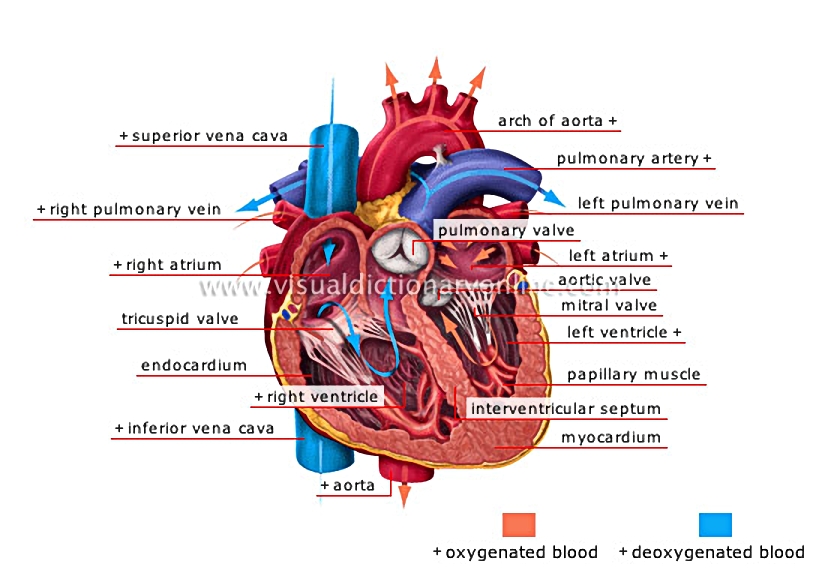
Muscular organ divided into four chambers; its regular rhythmic contractions cause blood to circulate throughout the organism.
heart 						Smooth thin inner casing of the heart attached to the myocardium.				  							Thick muscular casing around the heart; its contraction is involuntary and depends on the autonomous nervous system.				  							Vein carrying blood deoxygenated in the lower portion of the body (below the diaphragm) to the right atrium; it is the largest vein in the organism.												Second segment of the aorta, which branches into the arteries flowing to the head and upper limbs; with the ascending aorta, it forms the arch of the aorta.												Vein carrying deoxygenated blood from the upper body (above the diaphragm) back to the right atrium.												Each of two veins returning blood oxygenated in the right lung to the left atrium of the heart.												Membranous fold made up of three walls; it carries blood from the right atrium to the right ventricle and prevents its reflux.				  							Main artery of the body that originates in the left ventricle of the heart and is made up of four segments; it distributes oxygenated blood throughout the body.												Thin-walled heart cavity receiving deoxygenated blood from the right atrium; it then forces it into the pulmonary artery leading to the lungs.												Internal ventricular muscle restraining the mitral or tricuspid valve and preventing it from being pushed back into the atrium during contraction of the ventricle.				  							Mostly muscular partition separating the right and left ventricles of the heart.				  							Thick-walled heart cavity receiving oxygenated blood from the left atrium; it then forces it into the aorta to circulate throughout the organism.												Membranous fold made up of two walls; it carries blood from the left atrium to the left ventricle and prevents its reflux.				  							Membranous fold made up of three walls; it carries blood from the left ventricle to the aorta and prevents its reflux.				  							Each of two veins returning blood, oxygenated in the left lung, to the left atrium of the heart.				  							Heart cavity receiving oxygenated blood from the lungs via four pulmonary veins; it then forces it into the left ventricle.												Membranous fold made up of three walls; it carries blood from the right ventricle to the pulmonary artery and prevents its reflux.				  							Artery carrying blood that is poor in oxygen and rich in carbon dioxide to the lungs; this is the only artery that transports oxygen-poor blood.												Heart cavity receiving deoxygenated blood from the lower and upper venae cavae; it then forces it into the right ventricle.												Blood whose oxygen is depleted; the veins carry it to the right portion of the heart, after which it is re-oxygenated in the lungs.												Blood enriched with oxygen in the lungs; it leaves the left section of the heart and flows through the arteries to distribute oxygen and nutrients to the organism.
See Also


schema of circulation

respiratory system

principal veins and arteries

endocardium

Smooth thin inner casing of the heart attached to the myocardium.

myocardium

Thick muscular casing around the heart; its contraction is involuntary and depends on the autonomous nervous system.

inferior vena cava

Vein carrying blood deoxygenated in the lower portion of the body (below the diaphragm) to the right atrium; it is the largest vein in the organism.
schema of circulation

arch of aorta

Second segment of the aorta, which branches into the arteries flowing to the head and upper limbs; with the ascending aorta, it forms the arch of the aorta.
schema of circulation

superior vena cava

Vein carrying deoxygenated blood from the upper body (above the diaphragm) back to the right atrium.
schema of circulation

right pulmonary vein

Each of two veins returning blood oxygenated in the right lung to the left atrium of the heart.
respiratory system
respiratory system

tricuspid valve

Membranous fold made up of three walls; it carries blood from the right atrium to the right ventricle and prevents its reflux.

aorta

Main artery of the body that originates in the left ventricle of the heart and is made up of four segments; it distributes oxygenated blood throughout the body.
respiratory system
respiratory system

right ventricle

Thin-walled heart cavity receiving deoxygenated blood from the right atrium; it then forces it into the pulmonary artery leading to the lungs.
schema of circulation

papillary muscle

Internal ventricular muscle restraining the mitral or tricuspid valve and preventing it from being pushed back into the atrium during contraction of the ventricle.

interventricular septum

Mostly muscular partition separating the right and left ventricles of the heart.

left ventricle

Thick-walled heart cavity receiving oxygenated blood from the left atrium; it then forces it into the aorta to circulate throughout the organism.
schema of circulation

mitral valve

Membranous fold made up of two walls; it carries blood from the left atrium to the left ventricle and prevents its reflux.

aortic valve

Membranous fold made up of three walls; it carries blood from the left ventricle to the aorta and prevents its reflux.

left pulmonary vein

Each of two veins returning blood, oxygenated in the left lung, to the left atrium of the heart.

left atrium

Heart cavity receiving oxygenated blood from the lungs via four pulmonary veins; it then forces it into the left ventricle.
schema of circulation

pulmonary valve

Membranous fold made up of three walls; it carries blood from the right ventricle to the pulmonary artery and prevents its reflux.

pulmonary artery

Artery carrying blood that is poor in oxygen and rich in carbon dioxide to the lungs; this is the only artery that transports oxygen-poor blood.
respiratory system
respiratory system

right atrium

Heart cavity receiving deoxygenated blood from the lower and upper venae cavae; it then forces it into the right ventricle.
schema of circulation

deoxygenated blood

Blood whose oxygen is depleted; the veins carry it to the right portion of the heart, after which it is re-oxygenated in the lungs.
respiratory system
respiratory system

oxygenated blood

Blood enriched with oxygen in the lungs; it leaves the left section of the heart and flows through the arteries to distribute oxygen and nutrients to the organism.
respiratory system
respiratory system