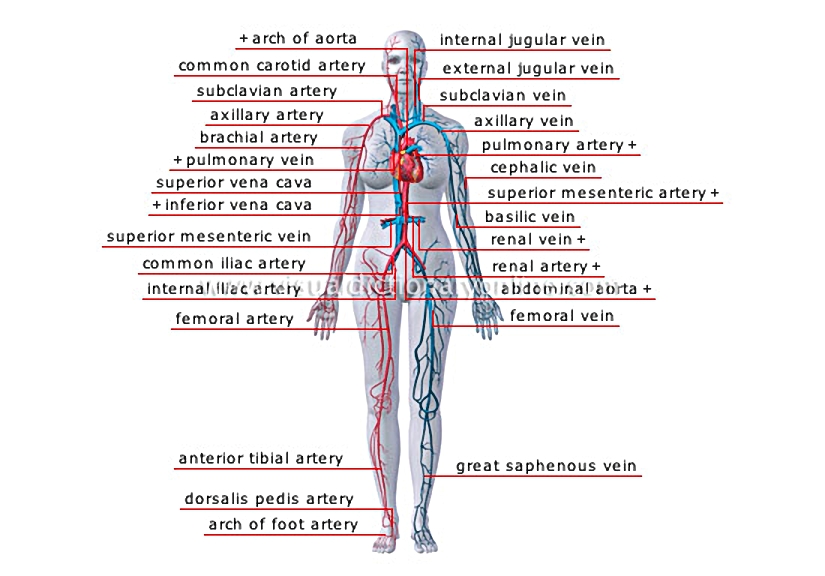
principal veins and arteries
Arteries distribute oxygenated blood throughout the body, while veins carry deoxygenated blood to the heart. Pulmonary arteries and veins function differently.
internal iliac artery
Branch of the common iliac artery flowing to the pelvis, the genital organs and the inner thigh.
superior vena cava
Vein carrying deoxygenated blood from the upper body (above the diaphragm) back to the right atrium.
great saphenous vein
Superficial vein collecting blood from the inner leg and thigh and receiving blood from certain veins of the foot; it is the longest vein in the body.
abdominal aorta
Fourth segment of the aorta circulating to all the organs and to the walls of the abdomen; it branches into the common iliac arteries.
femoral vein
Vein collecting blood from the deep structures of the thighs and receives blood from the great saphenous vein, among others.
superior mesenteric artery
Branch of the abdominal aorta that supplies blood to the ascending colon and half of the transverse colon.
renal artery
Branch of the abdominal aorta circulating blood to the kidney.
renal vein
Large vein collecting blood from the kidney; it flows into the inferior vena cava.
pulmonary artery
Artery carrying blood that is poor in oxygen and rich in carbon dioxide to the lungs; it is the only artery that transports oxygen-poor blood.
basilic vein
Large superficial vein of the inner surface of the arm; it connects to the humeral vein in the armpit to form the axillary vein.
cephalic vein
Superficial vein of the outer arm emptying into the axillary vein; it also receives blood from the superficial veins of the shoulder.
arch of aorta
Second segment of the aorta, which branches into the arteries flowing to the head and upper limbs; with the ascending aorta, it forms the arch of the aorta.
axillary vein
Deep vein running through the hollow of the armpit and ending at the subclavian vein; it receives the flow of the shoulder and thorax veins, among others.
subclavian vein
Vein collecting blood from the arm and part of the neck and face; it passes beneath the clavicle and receives the flow of the external jugular vein, among others.
external jugular vein
Vein carrying blood from the cranial walls, deep regions of the face and outer walls of the neck to the subclavian vein.
internal jugular vein
Vein collecting blood from the encephalon and from one portion of the face and neck; it is the largest vein in the neck.
dorsalis pedis artery
Artery flowing to the ankle and the back of the foot.
anterior tibial artery
Artery running along the front of the leg and supplying blood to the extensor muscles; it extends through the dorsal artery of the foot.
femoral artery
Main artery of the lower limb; it is a continuation of the external iliac artery and runs along the femur.
common iliac artery
Branch of the abdominal aorta that circulates blood to the pelvis and the lower limbs; it divides into the internal and external iliac arteries.
superior mesenteric vein
Vein collecting blood from a section of the intestine (small intestine, right colon); it is one of the veins that flows into the portal vein.
inferior vena cava
Vein carrying blood deoxygenated in the lower portion of the body (below the diaphragm) to the right atrium; it is the largest vein in the organism.
pulmonary vein
Vein that returns blood to the heart after it has been oxygenated in the lungs; unlike other veins, the pulmonary veins carry oxygen-rich blood.
brachial artery
Artery flowing along the humerus and supplying the flexor muscles of the arm; it divides into the radial and ulnar arteries at the bend in the elbow.
axillary artery
Artery crossing the hollow of the armpit and extending through the brachial artery; it also circulates through the thoracic wall and the shoulder.
subclavian artery
Main artery of the upper limb passing through the clavicle and extending through the axillary artery; it also flows to the lower section of the neck.
common carotid artery
Branch of the aorta flowing to the head and upper portion of the neck; it is divided into internal and external carotid arteries.
![cross-section-molar [2]](../../../images/flechePrevious.gif "cross-section-molar [2] image") previous
previous


