profile of the Earth’s atmosphere

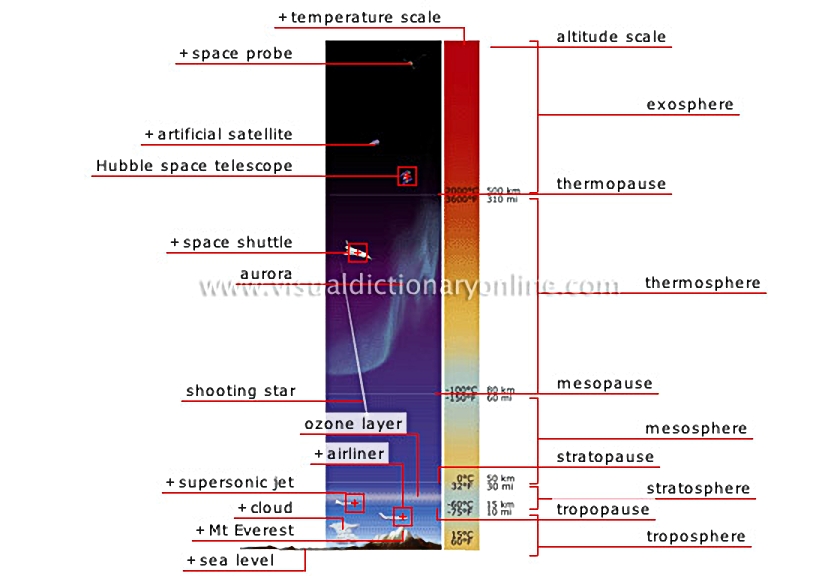
Atmosphere: layer of air that surrounds the Earth and is composed mainly of nitrogen (78%) and oxygen (21%); its density decreases with altitude.
profile of the Earth’s atmosphere 						Unmanned craft launched in the direction of a celestial body in the solar system for purposes of studying it.												Observation spacecraft placed in orbit around the Earth.												It orbits at an altitude of about 250 mi.												Luminous phenomenon that occurs at high altitudes near the Earth’s poles.				  							Luminous trace produced when a meteorite burns up as it enters the Earth’s atmosphere.				  							Commercial aircraft that makes regular flights of variable duration, depending on the distance covered; it flies at altitudes of 39,000 feet.												Layer of gas that absorbs a large part of the Sun’s ultraviolet rays.				  							The world’s highest peak rises to an elevation of 29,035 feet.												Aircraft whose cruising speed is faster than the speed of sound; it flies at altitudes of 62,000 feet.												Fine droplets of water or ice crystals suspended in the atmosphere.												Average height of seawater observed for a given time (day, month, year); it is used as a reference point to define coastal features and measure land elevations.												The most dense layer, which produces most of the meteorological phenomena and where temperatures decrease with altitude.				  							Highly stable layer of air where temperatures increase with altitude due to the absorption of solar radiation by the ozone layer.				  							The boundary between the troposphere and the stratosphere; its altitude varies depending on the season, ground temperature, latitude and atmospheric pressure.				  							Thin transition layer between the stratosphere and the mesosphere.				  							The atmosphere’s coldest layer, where temperatures decrease with altitude.				  							Thin transition layer between the mesosphere and the thermosphere.				  							Layer that absorbs a large portion of solar radiation, leading to a steady increase in its temperature.				  							Thin transition layer between the thermosphere and the exosphere.				  							The outermost region of the atmosphere, where low-density gases disperse into space.				  					  					  							Telescope placed in orbit above Earth’s atmosphere (370 mi), making it possible to observe the universe as never before.
See Also


examples of space probes?[1]

geostationary satellite

cross section of a space launcher (Ariane V)?[1]

orbit of the satellites

Radarsat satellite

airport

mountain

clouds?[1]

structure of the Earth

orbiter

long-range jet

supersonic jetliner

Hubble space telescope?[1]

space probe

Unmanned craft launched in the direction of a celestial body in the solar system for purposes of studying it.
examples of space probes [1]

artificial satellite

Observation spacecraft placed in orbit around the Earth.
geostationary satellite
cross section of a space launcher (Ariane V) [1]
orbit of the satellites
Radarsat satellite
Radarsat satellite

space shuttle

It orbits at an altitude of about 250 mi.
orbiter
orbiter

aurora

Luminous phenomenon that occurs at high altitudes near the Earth’s poles.

shooting star

Luminous trace produced when a meteorite burns up as it enters the Earth’s atmosphere.

airliner

Commercial aircraft that makes regular flights of variable duration, depending on the distance covered; it flies at altitudes of 39,000 feet.
airport
airport
long-range jet
long-range jet

ozone layer

Layer of gas that absorbs a large part of the Sun’s ultraviolet rays.

Mt Everest

The world’s highest peak rises to an elevation of 29,035 feet.
mountain
mountain

supersonic jet

Aircraft whose cruising speed is faster than the speed of sound; it flies at altitudes of 62,000 feet.
airport
airport
supersonic jetliner
supersonic jetliner

cloud

Fine droplets of water or ice crystals suspended in the atmosphere.
clouds [1]
clouds [1]

sea level

Average height of seawater observed for a given time (day, month, year); it is used as a reference point to define coastal features and measure land elevations.
structure of the Earth

troposphere

The most dense layer, which produces most of the meteorological phenomena and where temperatures decrease with altitude.

stratosphere

Highly stable layer of air where temperatures increase with altitude due to the absorption of solar radiation by the ozone layer.

tropopause

The boundary between the troposphere and the stratosphere; its altitude varies depending on the season, ground temperature, latitude and atmospheric pressure.

stratopause

Thin transition layer between the stratosphere and the mesosphere.

mesosphere

The atmosphere’s coldest layer, where temperatures decrease with altitude.

mesopause

Thin transition layer between the mesosphere and the thermosphere.

thermosphere

Layer that absorbs a large portion of solar radiation, leading to a steady increase in its temperature.

thermopause

Thin transition layer between the thermosphere and the exosphere.

exosphere

The outermost region of the atmosphere, where low-density gases disperse into space.

temperature scale

altitude scale

Hubble space telescope

Telescope placed in orbit above Earth’s atmosphere (370 mi), making it possible to observe the universe as never before.
Hubble space telescope [1]