structure of the Earth

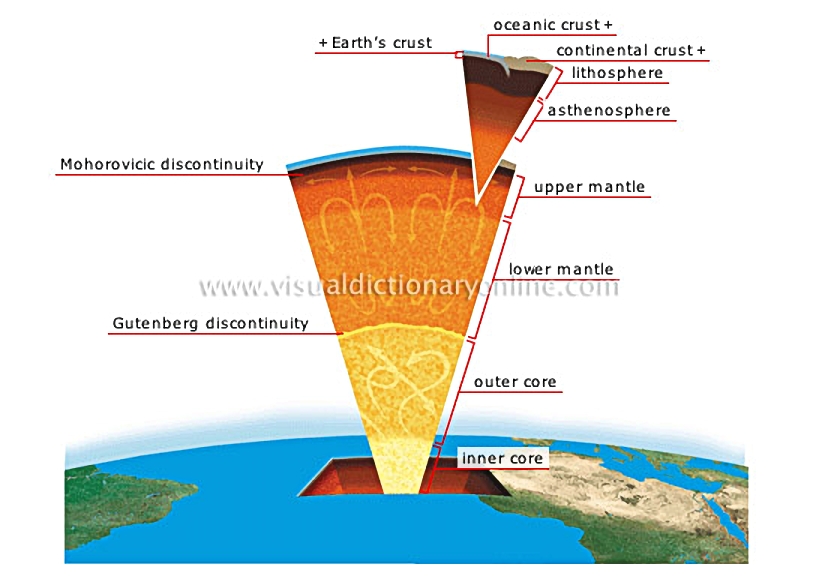
The Earth is formed of three concentric layers: the core, the mantle and the crust; these are separated by transition zones called discontinuities.
structure of the Earth 						Layer from 30 to 60 mi thick that comprises the Earth’s crust and the solid part of the upper mantle; it is divided into tectonic plates.				  							Layer varying in thickness from 20 to 45 mi and composed mainly of granite. It forms a number of distinct landforms: the continents.												Layer of the upper mantle with a thickness of 125 mi; it is composed of molten rock, on top of which the lithospheric plates slide.				  							Zone that separates the Earth’s crust from the asthenosphere.				  							Zone separating the lower mantle from the core; it is located at a depth of about 1,800 mi.				  							Little-known layer with a thickness of about 1,420 mi; its slow-moving currents, called convection currents, are caused by temperature variations.				  							Composed of molten metal, it is 1,130 mi thick; the magnetic field is caused by electric currents circulating inside the outer core.				  							Composed of iron and nickel, it is subject to so much pressure that it remains in a solid state in spite of temperatures higher than 9,000°F; its diameter is 1,000 mi.				  							Layer forming the ocean floor; it is thinner, denser and younger than the continental crust.												Solid layer at the Earth’s surface whose thickness varies from 6 mi beneath the oceans to 35 mi beneath the mountains.												Layer of hard rock nearly 390 mi thick; it is made up of the asthenosphere and the base of the lithosphere.
See Also


section of the Earths crust

ocean floor

ocean trenches and ridges

tectonic plates

lithosphere

Layer from 30 to 60 mi thick that comprises the Earth’s crust and the solid part of the upper mantle; it is divided into tectonic plates.

continental crust

Layer varying in thickness from 20 to 45 mi and composed mainly of granite. It forms a number of distinct landforms: the continents.
section of the Earth’s crust

asthenosphere

Layer of the upper mantle with a thickness of 125 mi; it is composed of molten rock, on top of which the lithospheric plates slide.

Mohorovicic discontinuity

Zone that separates the Earth’s crust from the asthenosphere.

Gutenberg discontinuity

Zone separating the lower mantle from the core; it is located at a depth of about 1,800 mi.

lower mantle

Little-known layer with a thickness of about 1,420 mi; its slow-moving currents, called convection currents, are caused by temperature variations.

outer core

Composed of molten metal, it is 1,130 mi thick; the magnetic field is caused by electric currents circulating inside the outer core.

inner core

Composed of iron and nickel, it is subject to so much pressure that it remains in a solid state in spite of temperatures higher than 9,000°F; its diameter is 1,000 mi.

oceanic crust

Layer forming the ocean floor; it is thinner, denser and younger than the continental crust.
ocean floor
ocean floor
ocean trenches and ridges

Earth’s crust

Solid layer at the Earth’s surface whose thickness varies from 6 mi beneath the oceans to 35 mi beneath the mountains.
section of the Earth’s crust

upper mantle

Layer of hard rock nearly 390 mi thick; it is made up of the asthenosphere and the base of the lithosphere.