orbiter

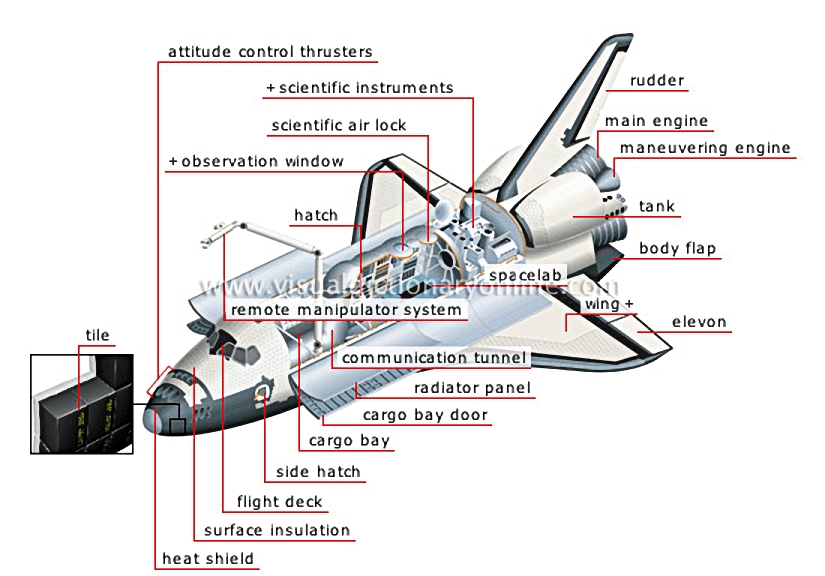
The only part of the shuttle to fly in orbit; can transport 13 tons of material and five to seven astronauts.
orbiter 						Door allowing the crew to embark and disembark before the launch and after the return to Earth.				  							Protects the orbiter nose from heat caused by friction when the vehicle enters the atmosphere; covered with carbon fiber, it can withstand temperatures over 2,900°F.				  							Small rocket engines that direct the orbiter to the desired position.				  							Protects against heat so that the orbiter does not burn up on re-entry into the atmosphere.				  							Forward section of the orbiter housing the crew, flight-control equipment and monitor.				  							Shuttle compartment that stores various types of cargo, depending on the mission (satellite, probe, laboratory, telescope).				  							Mechanical arm used to handle and move shuttle cargo.				  							Discharges into space the heat produced by the functioning of onboard equipment.				  							Remains open in orbit so as to expose the content of the cargo bay to space.				  							Opening that provides access to the communications tunnel.				  							Area where scientific experiments on weightlessness are carried out.				  							Horizontal surface acted on by aerodynamic forces that keep the orbiter aloft in the atmosphere.												Each of the two ailerons controls pitching during landing.				  							Part serving as a thermal shield for the motors during re-entry into the atmosphere.				  							Contains fuel for the maneuvering engines and the directional control thrusters.				  							Each of the orbiter’s three tail engines used during takeoff; these only function for the first 8 min. of flight.				  							Used to place the vehicle in orbit, to provide thrust in case the orbit changes and to take the vehicle out of orbit.				  							Mobile vertical part that allows the orbiter to set its direction when landing.				  							Varying for each mission, they make it possible, for example, to study meteorological conditions, pollution and cosmic radiation.				  							Door making it possible to expose equipment to the space vacuum.				  							Corridor that allows the astronauts to go from the orbiter crew compartment to the laboratory.				  							Window that makes it possible to see outside the orbiter.				  							Covering 70% of the orbiter, the tiles protect it from heat on re-entry into the atmosphere.
See Also


delta wing

profile of the Earths atmosphere

spacesuit

space shuttle at takeoff

side hatch

Door allowing the crew to embark and disembark before the launch and after the return to Earth.

heat shield

Protects the orbiter nose from heat caused by friction when the vehicle enters the atmosphere; covered with carbon fiber, it can withstand temperatures over 2,900°F.

attitude control thrusters

Small rocket engines that direct the orbiter to the desired position.

surface insulation

Protects against heat so that the orbiter does not burn up on re-entry into the atmosphere.

flight deck

Forward section of the orbiter housing the crew, flight-control equipment and monitor.

cargo bay

Shuttle compartment that stores various types of cargo, depending on the mission (satellite, probe, laboratory, telescope).

remote manipulator system

Mechanical arm used to handle and move shuttle cargo.

radiator panel

Discharges into space the heat produced by the functioning of onboard equipment.

cargo bay door

Remains open in orbit so as to expose the content of the cargo bay to space.

hatch

Opening that provides access to the communications tunnel.

spacelab

Area where scientific experiments on weightlessness are carried out.

wing

Horizontal surface acted on by aerodynamic forces that keep the orbiter aloft in the atmosphere.
delta wing
delta wing

elevon

Each of the two ailerons controls pitching during landing.

body flap

Part serving as a thermal shield for the motors during re-entry into the atmosphere.

tank

Contains fuel for the maneuvering engines and the directional control thrusters.

main engine

Each of the orbiter’s three tail engines used during takeoff; these only function for the first 8 min. of flight.

maneuvering engine

Used to place the vehicle in orbit, to provide thrust in case the orbit changes and to take the vehicle out of orbit.

rudder

Mobile vertical part that allows the orbiter to set its direction when landing.

scientific instruments

Varying for each mission, they make it possible, for example, to study meteorological conditions, pollution and cosmic radiation.

scientific air lock

Door making it possible to expose equipment to the space vacuum.

communication tunnel

Corridor that allows the astronauts to go from the orbiter crew compartment to the laboratory.

observation window

Window that makes it possible to see outside the orbiter.

tile

Covering 70% of the orbiter, the tiles protect it from heat on re-entry into the atmosphere.