planets and satellites

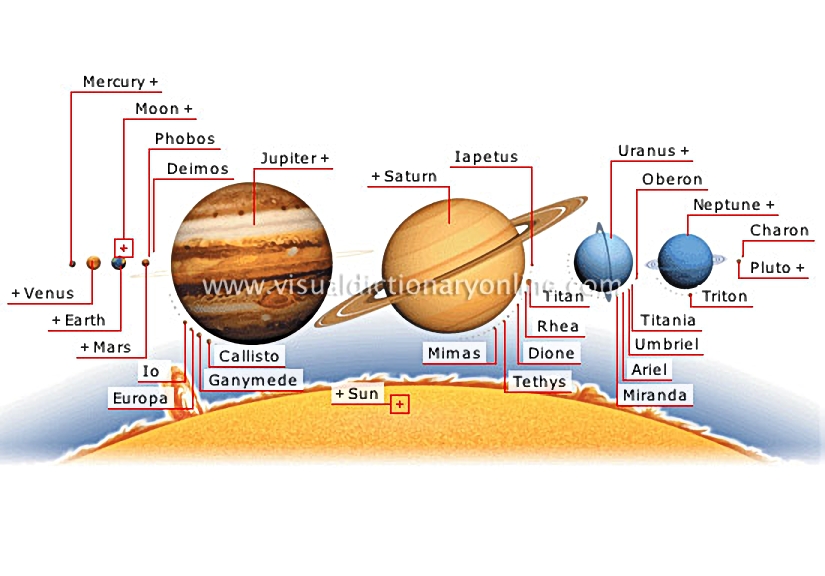
Planets, dwarf planets and plutoids orbit the Sun, satellites orbit the planets. They are represented from left to right from the Sun, based on their relative sizes.
planets and satellites 						Star around which the planets gravitate; represents over 99.8% of the total mass of the solar system.												Fifth planet from the Sun, also the largest; Jupiter is 1,330 times the size of Earth.												Satellite of Jupiter; the celestial body with the greatest number of active volcanoes.				  							Satellite of Jupiter; displays a surface layer of ice that might cover liquid water.				  							Satellite of Jupiter; its heavily cratered surface indicates that Callisto is very old.				  							Satellite of Jupiter; the largest natural satellite in the solar system; its glacial surface is thought to cover an ocean and a mantle.				  							The planet closest to the Sun; devoid of atmosphere, heavily cratered and marked by extreme variations in temperature (-300°F to 800°F).												Second planet from the Sun; its density and chemical composition are similar to those of Earth.												Third planet from the Sun, inhabited by humankind; up to now, the only planet with evidence of life.												Earth’s only natural satellite; devoid of water and atmosphere and characterized by a highly uneven surface.												Satellite of Mars; slightly larger than Deimos, Phobos features a large crater named Stickney.				  							Fourth planet from the Sun; its crust contains iron oxide, giving Mars its reddish color.												Satellite of Mars; one of the smallest natural satellites in the solar system, its surface displays numerous craters.				  							Sixth planet from the Sun, also the second largest planet; Saturn is encircled by rings forming a band about 120,000 mi in diameter.												Saturn’s largest satellite, 1.5 times the diameter of the Moon.				  							Seventh planet from the Sun, also the third largest planet; Uranus is composed mainly of rock, ice and hydrogen and features 11 rings.												Discovered in 1930, it was long considered the ninth planet of the solar system. Since 2008, it has been classified as a plutoid.												Pluto’s only satellite; almost equal in size and mass to the planet itself.				  							Neptune’s largest satellite; together with Pluto, Triton is the coldest object in the solar system.				  							Eighth planet from the Sun; its atmosphere, composed of hydrogen, helium and methane, gives Neptune its bluish color. Features four rings.												Satellite of Saturn; its cratered surface is covered with ice as hard as rock.				  							Satellite of Saturn; its cratered surface features ice deposits.				  							Satellite of Saturn thought to be composed of ice; visible on its surface is an immense impact crater named Odysseus.				  							Satellite of Saturn; features a crater named Herschel spanning one-third of its surface.				  							The most distant satellite of Uranus; its craters are often surrounded by light rays.				  							The largest satellite of Uranus; its surface displays numerous valleys and faults.				  							Satellite of Uranus; its heavily cratered surface is very dark.				  							Satellite of Uranus; its cratered surface is composed of numerous long valleys and extremely high escarpments.				  							Satellite of Uranus whose surface is cratered in places; displays vast expanses of arêtes and furrows.				  							Satellite of Saturn featuring a bright side composed of ice and a dark side composed of unknown matter.
See Also


seasons of the year

outer planets

inner planets

Earth coordinate system

section of the Earths crust

planisphere

solar eclipse

lunar eclipse

phases of the Moon

structure of the Sun?[1]

lunar features

Sun

Star around which the planets gravitate; represents over 99.8% of the total mass of the solar system.
seasons of the year
seasons of the year
structure of the Sun [1]

Jupiter

Fifth planet from the Sun, also the largest; Jupiter is 1,330 times the size of Earth.
outer planets
outer planets

Io

Satellite of Jupiter; the celestial body with the greatest number of active volcanoes.

Europa

Satellite of Jupiter; displays a surface layer of ice that might cover liquid water.

Callisto

Satellite of Jupiter; its heavily cratered surface indicates that Callisto is very old.

Ganymede

Satellite of Jupiter; the largest natural satellite in the solar system; its glacial surface is thought to cover an ocean and a mantle.

Mercury

The planet closest to the Sun; devoid of atmosphere, heavily cratered and marked by extreme variations in temperature (-300°F to 800°F).
inner planets
inner planets

Venus

Second planet from the Sun; its density and chemical composition are similar to those of Earth.
inner planets
inner planets

Earth

Third planet from the Sun, inhabited by humankind; up to now, the only planet with evidence of life.
Earth coordinate system
section of the Earth’s crust
planisphere
planisphere
inner planets
inner planets

Moon

Earth’s only natural satellite; devoid of water and atmosphere and characterized by a highly uneven surface.
solar eclipse
solar eclipse
lunar eclipse
lunar eclipse
phases of the Moon
phases of the Moon
lunar features
lunar features

Phobos

Satellite of Mars; slightly larger than Deimos, Phobos features a large crater named Stickney.

Mars

Fourth planet from the Sun; its crust contains iron oxide, giving Mars its reddish color.
inner planets
inner planets

Deimos

Satellite of Mars; one of the smallest natural satellites in the solar system, its surface displays numerous craters.

Saturn

Sixth planet from the Sun, also the second largest planet; Saturn is encircled by rings forming a band about 120,000 mi in diameter.
outer planets
outer planets

Titan

Saturn’s largest satellite, 1.5 times the diameter of the Moon.

Uranus

Seventh planet from the Sun, also the third largest planet; Uranus is composed mainly of rock, ice and hydrogen and features 11 rings.
outer planets
outer planets

Pluto

Discovered in 1930, it was long considered the ninth planet of the solar system. Since 2008, it has been classified as a plutoid.
outer planets
outer planets

Charon

Pluto’s only satellite; almost equal in size and mass to the planet itself.

Triton

Neptune’s largest satellite; together with Pluto, Triton is the coldest object in the solar system.

Neptune

Eighth planet from the Sun; its atmosphere, composed of hydrogen, helium and methane, gives Neptune its bluish color. Features four rings.
outer planets
outer planets

Rhea

Satellite of Saturn; its cratered surface is covered with ice as hard as rock.

Dione

Satellite of Saturn; its cratered surface features ice deposits.

Tethys

Satellite of Saturn thought to be composed of ice; visible on its surface is an immense impact crater named Odysseus.

Mimas

Satellite of Saturn; features a crater named Herschel spanning one-third of its surface.

Oberon

The most distant satellite of Uranus; its craters are often surrounded by light rays.

Titania

The largest satellite of Uranus; its surface displays numerous valleys and faults.

Umbriel

Satellite of Uranus; its heavily cratered surface is very dark.

Ariel

Satellite of Uranus; its cratered surface is composed of numerous long valleys and extremely high escarpments.

Miranda

Satellite of Uranus whose surface is cratered in places; displays vast expanses of arêtes and furrows.

Iapetus

Satellite of Saturn featuring a bright side composed of ice and a dark side composed of unknown matter.