outer planets

Planets located beyond the asteroid belt; these are known as the gas giants.
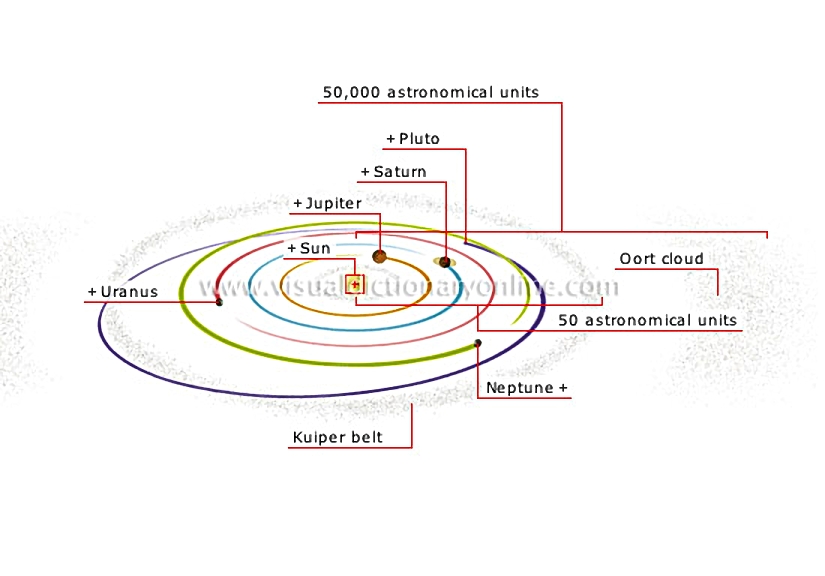
outer planets 						Corresponds to about 50 times the Earth-Sun distance.				  							Seventh planet from the Sun, also the third largest planet; Uranus is composed mainly of rock, ice and hydrogen and features 11 rings.												Eighth planet from the Sun; its atmosphere, composed of hydrogen, helium and methane, gives Neptune its bluish color. Features four rings.												Circular region of the solar system about 50 astronomical units from the Sun; thought to be a repository of small icy bodies, the source of comets.				  							Discovered in 1930, it was long considered the ninth planet of the solar system. Since 2008, it has been classified as a plutoid.												Sixth planet from the Sun, also the second largest planet; Saturn is encircled by rings forming a band about 120,000 mi in diameter.												Fifth planet from the Sun, also the largest; Jupiter is 1,330 times the size of Earth.												Star around which the planets gravitate; represents over 99.8% of the total mass of the solar system.												Region of space bordering the solar system about 50,000 astronomical units from the Sun; composed of billions of comets.				  							Corresponds to about 50,000 times the Earth-Sun distance.
See Also


planets and satellites

seasons of the year

inner planets

structure of the Sun?[1]

50 astronomical units

Corresponds to about 50 times the Earth-Sun distance.

Uranus

Seventh planet from the Sun, also the third largest planet; Uranus is composed mainly of rock, ice and hydrogen and features 11 rings.
planets and satellites

Neptune

Eighth planet from the Sun; its atmosphere, composed of hydrogen, helium and methane, gives Neptune its bluish color. Features four rings.
planets and satellites

Kuiper belt

Circular region of the solar system about 50 astronomical units from the Sun; thought to be a repository of small icy bodies, the source of comets.

Pluto

Discovered in 1930, it was long considered the ninth planet of the solar system. Since 2008, it has been classified as a plutoid.
planets and satellites

Saturn

Sixth planet from the Sun, also the second largest planet; Saturn is encircled by rings forming a band about 120,000 mi in diameter.
planets and satellites

Jupiter

Fifth planet from the Sun, also the largest; Jupiter is 1,330 times the size of Earth.
planets and satellites

Sun

Star around which the planets gravitate; represents over 99.8% of the total mass of the solar system.
seasons of the year
seasons of the year
planets and satellites
structure of the Sun [1]

Oort cloud

Region of space bordering the solar system about 50,000 astronomical units from the Sun; composed of billions of comets.

50,000 astronomical units

Corresponds to about 50,000 times the Earth-Sun distance.