symphony orchestra

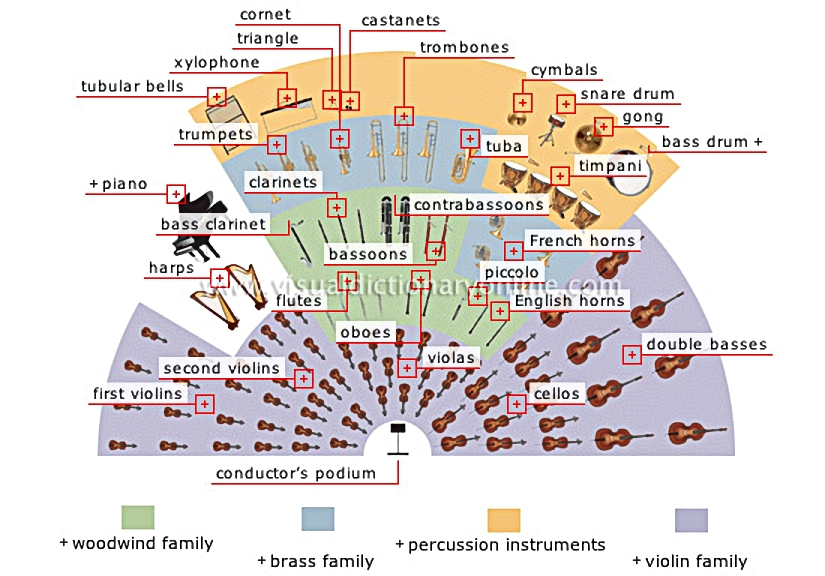
Group composed of numerous musicians under the direction of a conductor; it includes various categories of instruments, depending on the work to be performed.
symphony orchestra 						Double-reed instruments consisting of a curved conical wooden tube; the double-reed is inserted into a curved mouthpiece.												Valved instrument whose tonal range is the lowest in the brass family; it consists of a coiled conical tube and an upturned bell.												Instrument consisting of two metal disks that are struck together.												Flat drum consisting of two membranes; stretched across the lower head are snares that produce a rattling sound.												Instrument consisting of a large metal disk with a raised central portion that is struck using a mallet.												Instruments consisting of a parabolic copper basin covered with a stretched batter head that is struck with a mallet.												Large drum set on a vertical frame and struck using a pedal-controlled wooden mallet.												Valved instruments consisting of a coiled conical tube and a flared bell.												Double-reed instruments consisting of a conical tube with holes (some closed by keys) and a slightly flared bell.												Small transverse flute whose range is an octave higher than the regular transverse flute.												Four- or five-stringed instruments played upright; the largest of the violin family, they also have the lowest range.												Alto oboes with a pear-shaped bell.												Four-stringed instruments placed between the legs when played; they are about twice the size of a violin and their range is one octave lower than the viola.												Small dais that the conductor stands on to direct the musicians as they play.				  							Four-stringed instruments similar to a violin but played a fifth lower.												The violins that support the first violins.												The violins that play the melody.												Plucked stringed instruments consisting of strings of unequal length attached to a triangular frame.												Instruments with a side mouthpiece and a tube containing holes, some of which are closed by keys.												Single-reed instruments whose cylindrical tube contains holes (some closed by keys) and ends in a flared bell.												Piano whose mechanism is horizontal, allowing the pianist to better control the sound; it varies in size from 8 to 9 ft.												Clarinet with a curved tube; its range is one octave lower than the ordinary clarinet.				  							Valved instruments consisting of a curved cylindrical tube and a flared bell.												Series of metal tubes arranged vertically in order of size; small hammers are used to strike the tops of the tubes.												Double-reed wind instruments consisting of several tubes; their range is one octave lower than the bassoon.				  							Valved instrument consisting of a curved conical tube and a flared bell.												Instrument consisting of wooden bars placed on top of resonators arranged in chromatic order in two rows; the bars are struck with mallets.												Instrument composed of a metal bar bent to form a triangle open at one end; the triangle is struck with a metal rod.												Instruments consisting of a curved tube with a slide that is lengthened to produce notes varying in pitch by semitones.												Instrument composed of two shell-shaped pieces of wood held in one hand and struck together using the fingers.												Group of stringed instruments played with a bow.				  							Group of instruments that are struck directly with the hands or with sticks, mallets, etc. to produce a sound.												Group of wind instruments made from metal and played with cup-shaped mouthpieces.												Group of wind instruments originally made from wood.
See Also


drums

examples of keyboard instruments

upright piano

percussion instruments?[1]

wind instruments?[1]

bassoon

tuba

cymbals

snare drum

gong

kettledrum

French horn

oboe

piccolo

double bass

English horn

cello

viola

violin

harp

transverse flute

clarinet

concert grand

trumpet

tubular bells

cornet

xylophone

triangle

trombone

castanets

bassoons

Double-reed instruments consisting of a curved conical wooden tube; the double-reed is inserted into a curved mouthpiece.
bassoon
bassoon

tuba

Valved instrument whose tonal range is the lowest in the brass family; it consists of a coiled conical tube and an upturned bell.
tuba
tuba

cymbals

Instrument consisting of two metal disks that are struck together.
cymbals
cymbals

snare drum

Flat drum consisting of two membranes; stretched across the lower head are snares that produce a rattling sound.
snare drum
snare drum

gong

Instrument consisting of a large metal disk with a raised central portion that is struck using a mallet.
gong
gong

timpani

Instruments consisting of a parabolic copper basin covered with a stretched batter head that is struck with a mallet.
kettledrum
kettledrum

bass drum

Large drum set on a vertical frame and struck using a pedal-controlled wooden mallet.
drums
drums

French horns

Valved instruments consisting of a coiled conical tube and a flared bell.
French horn
French horn

oboes

Double-reed instruments consisting of a conical tube with holes (some closed by keys) and a slightly flared bell.
oboe
oboe

piccolo

Small transverse flute whose range is an octave higher than the regular transverse flute.
piccolo
piccolo

double basses

Four- or five-stringed instruments played upright; the largest of the violin family, they also have the lowest range.
double bass
double bass

English horns

Alto oboes with a pear-shaped bell.
English horn
English horn

cellos

Four-stringed instruments placed between the legs when played; they are about twice the size of a violin and their range is one octave lower than the viola.
cello
cello

conductor’s podium

Small dais that the conductor stands on to direct the musicians as they play.

violas

Four-stringed instruments similar to a violin but played a fifth lower.
viola
viola

second violins

The violins that support the first violins.
violin
violin

first violins

The violins that play the melody.
violin
violin

harps

Plucked stringed instruments consisting of strings of unequal length attached to a triangular frame.
harp
harp

flutes

Instruments with a side mouthpiece and a tube containing holes, some of which are closed by keys.
transverse flute
transverse flute

clarinets

Single-reed instruments whose cylindrical tube contains holes (some closed by keys) and ends in a flared bell.
clarinet
clarinet

piano

Piano whose mechanism is horizontal, allowing the pianist to better control the sound; it varies in size from 8 to 9 ft.
examples of keyboard instruments
upright piano
upright piano
concert grand
concert grand

bass clarinet

Clarinet with a curved tube; its range is one octave lower than the ordinary clarinet.

trumpets

Valved instruments consisting of a curved cylindrical tube and a flared bell.
trumpet
trumpet

tubular bells

Series of metal tubes arranged vertically in order of size; small hammers are used to strike the tops of the tubes.
tubular bells
tubular bells

contrabassoons

Double-reed wind instruments consisting of several tubes; their range is one octave lower than the bassoon.

cornet

Valved instrument consisting of a curved conical tube and a flared bell.
cornet
cornet

xylophone

Instrument consisting of wooden bars placed on top of resonators arranged in chromatic order in two rows; the bars are struck with mallets.
xylophone
xylophone

triangle

Instrument composed of a metal bar bent to form a triangle open at one end; the triangle is struck with a metal rod.
triangle
triangle

trombones

Instruments consisting of a curved tube with a slide that is lengthened to produce notes varying in pitch by semitones.
trombone
trombone

castanets

Instrument composed of two shell-shaped pieces of wood held in one hand and struck together using the fingers.
castanets
castanets

violin family

Group of stringed instruments played with a bow.

percussion instruments

Group of instruments that are struck directly with the hands or with sticks, mallets, etc. to produce a sound.
percussion instruments [1]

brass family

Group of wind instruments made from metal and played with cup-shaped mouthpieces.
wind instruments [1]

woodwind family

Group of wind instruments originally made from wood.
wind instruments [1]