violin

Four-stringed instrument that the musician plays with a bow and holds between the shoulder and the chin.
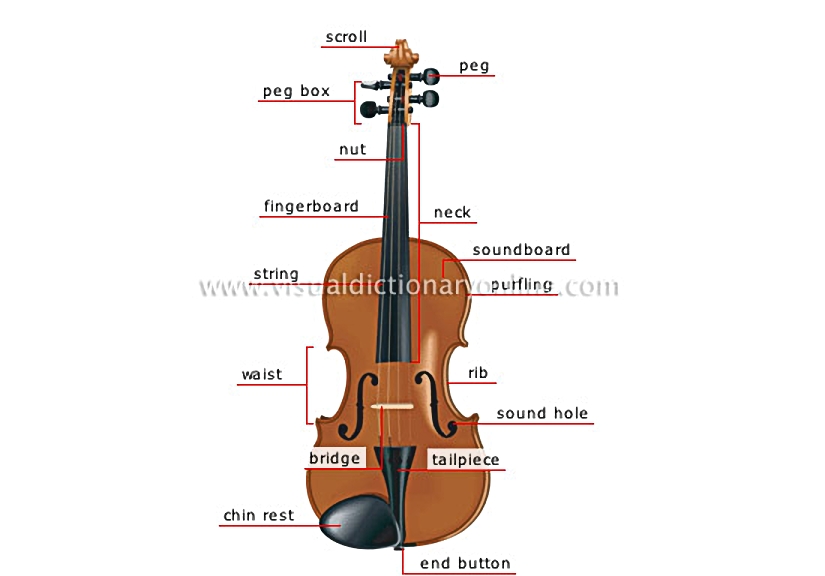
violin 						Small piece glued to the top of the neck; its function is to separate the strings and to raise them between the peg box and the bridge.				  							Each of the openings whose function is to release sound from the sound box.				  							Each of the instrument’s side notches in the shape of an inverted C.				  							Piece of wood or metal that rolls the end of a string to adjust its tension to obtain the exact note.				  							The head of a stringed instrument, where the pegs are inserted.				  							Slender piece of wood, usually maple, along which the strings are stretched.				  							Board on which the player’s fingers are placed to control the length of the vibrating string to determine the pitch of a note.				  							String made of gut or metal that is rubbed with a bow; its vibrations are transmitted to the bridge.				  							The upper, slightly convex face of the instrument; it has two holes and receives vibrations from the bridge, which it transmits to the sound box.				  							Ornamental strip of wood around the edge of the soundboard and the bottom of the sound box.				  							Piece of wood over which the strings are stretched; it transmits their vibrations to the soundboard.				  							Piece of wood to which the bottom ends of the strings are attached.				  							Slightly concave piece of wood or plastic on which the chin rests to hold the violin against the shoulder.				  							Ebony button used to attach the tailpiece to the sound box.				  							Each of the thin pieces of wood that form the sides of the instrument.				  							Spiral-shaped decorative end of the peg box.

See Also


violin family

bow

nut

Small piece glued to the top of the neck; its function is to separate the strings and to raise them between the peg box and the bridge.

sound hole

Each of the openings whose function is to release sound from the sound box.

waist

Each of the instrument’s side notches in the shape of an inverted C.

peg

Piece of wood or metal that rolls the end of a string to adjust its tension to obtain the exact note.

peg box

The head of a stringed instrument, where the pegs are inserted.

neck

Slender piece of wood, usually maple, along which the strings are stretched.

fingerboard

Board on which the player’s fingers are placed to control the length of the vibrating string to determine the pitch of a note.

string

String made of gut or metal that is rubbed with a bow; its vibrations are transmitted to the bridge.

soundboard

The upper, slightly convex face of the instrument; it has two holes and receives vibrations from the bridge, which it transmits to the sound box.

purfling

Ornamental strip of wood around the edge of the soundboard and the bottom of the sound box.

bridge

Piece of wood over which the strings are stretched; it transmits their vibrations to the soundboard.

tailpiece

Piece of wood to which the bottom ends of the strings are attached.

chin rest

Slightly concave piece of wood or plastic on which the chin rests to hold the violin against the shoulder.
end button

Ebony button used to attach the tailpiece to the sound box.

rib

Each of the thin pieces of wood that form the sides of the instrument.

scroll

Spiral-shaped decorative end of the peg box.