upright piano

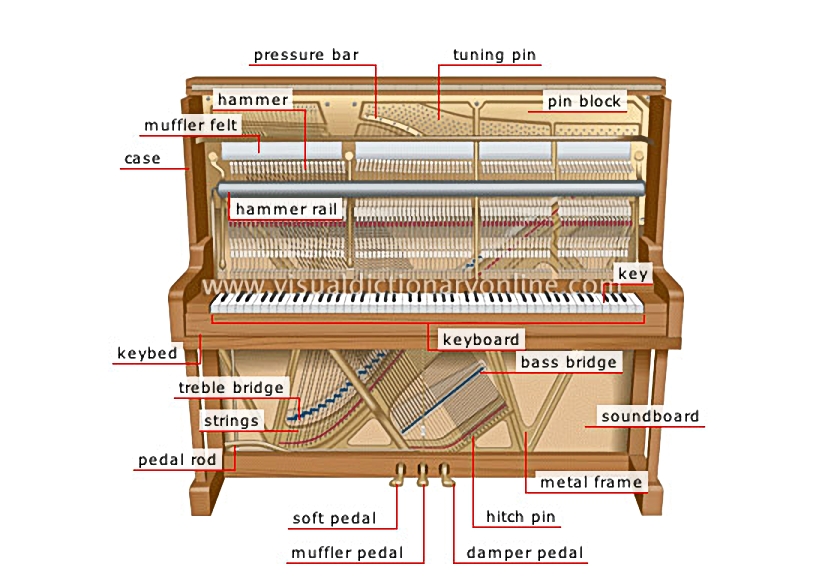
A stringed instrument whose strings are struck by hammers controlled by the keys on a keyboard; its soundboard and strings are arranged vertically.
upright piano 						Metal wires stretched between two fixed points; the hammers strike them, causing them to vibrate and produce sound.				  							Piece of wood over which the strings in the treble range are stretched; it transmits their vibrations to the soundboard.				  							Series of piano keys (52 white and 36 black).				  							In an upright piano, it lowers the muffler felt; in a grand piano, it prolongs the notes (sostenuto pedal).				  							Pedal that increases the duration of string resonance by keeping the dampers raised.				  							Piece attached to the metal frame; the lower end of the string attaches to it.				  							Piece of wood over which the bass strings are stretched; it transmits their vibrations to the soundboard.				  							Metal body that supports the tension of the strings.				  							Flat surface that amplifies the string vibrations transmitted by the bridges.				  							Part of the piano projecting from the case; it supports the keyboard.				  							In the upright piano, it brings the hammers closer to the strings to reduce their impact; in a grand piano, it limits the hammer impact to a section of the string.				  							Piece of wood that connects the pedal to the mechanism.				  							Felt-covered piece where the hammer shank rests when it falls back.				  							Strip of felt that comes between the strings and the hammer heads when the muffler pedal is pressed; it lowers the volume of sound.				  							Piece of wood or metal where the end of the string is attached; it adjusts string tension to obtain the exact tone.				  							Metal bar under which the strings pass, marking the top of the section of vibrating strings.				  							Piece of wood with a felt-covered end (head) that strikes one or more strings causing them to vibrate.				  							Wooden box that encloses the inner workings of the piano and protects them.				  							White or black lever pressed by the fingers to trigger a mechanism that causes the hammer to strike one or several strings.				  							Part in which the tuning pins are anchored.

See Also


examples of keyboard instruments

upright piano action

strings

Metal wires stretched between two fixed points; the hammers strike them, causing them to vibrate and produce sound.

treble bridge

Piece of wood over which the strings in the treble range are stretched; it transmits their vibrations to the soundboard.

keyboard

Series of piano keys (52 white and 36 black).

muffler pedal

In an upright piano, it lowers the muffler felt; in a grand piano, it prolongs the notes (sostenuto pedal).

damper pedal

Pedal that increases the duration of string resonance by keeping the dampers raised.

hitch pin

Piece attached to the metal frame; the lower end of the string attaches to it.

bass bridge

Piece of wood over which the bass strings are stretched; it transmits their vibrations to the soundboard.

metal frame

Metal body that supports the tension of the strings.

soundboard

Flat surface that amplifies the string vibrations transmitted by the bridges.

keybed

Part of the piano projecting from the case; it supports the keyboard.

soft pedal

In the upright piano, it brings the hammers closer to the strings to reduce their impact; in a grand piano, it limits the hammer impact to a section of the string.

pedal rod

Piece of wood that connects the pedal to the mechanism.

hammer rail

Felt-covered piece where the hammer shank rests when it falls back.

muffler felt

Strip of felt that comes between the strings and the hammer heads when the muffler pedal is pressed; it lowers the volume of sound.

tuning pin

Piece of wood or metal where the end of the string is attached; it adjusts string tension to obtain the exact tone.

pressure bar

Metal bar under which the strings pass, marking the top of the section of vibrating strings.

hammer

Piece of wood with a felt-covered end (head) that strikes one or more strings causing them to vibrate.

case

Wooden box that encloses the inner workings of the piano and protects them.

key

White or black lever pressed by the fingers to trigger a mechanism that causes the hammer to strike one or several strings.
pin block

Part in which the tuning pins are anchored.