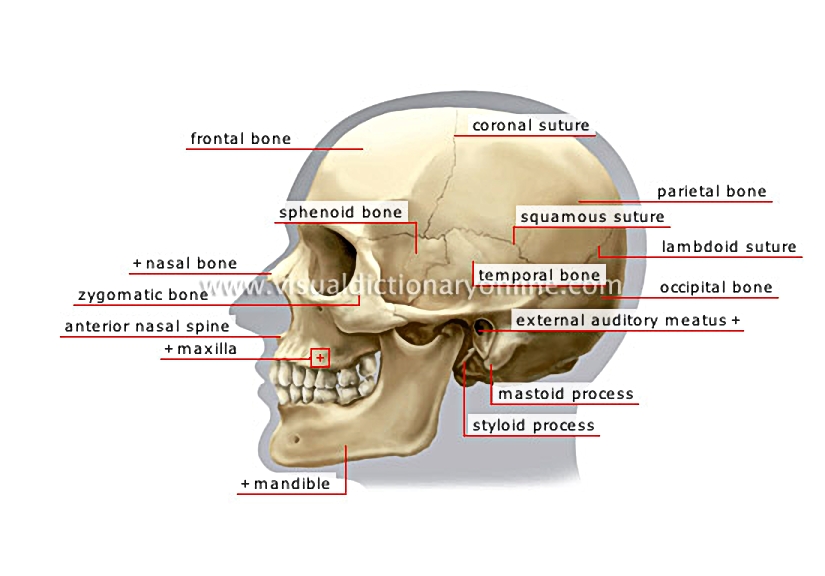
lateral view of skull

Skull: bony structure enclosing and protecting the brain. The eight cranial bones in an adult are fused to each other by means of sutures.
lateral view of skull 						Flat skull bone that protects mainly the organs responsible for hearing and equilibrium.				  							Flat skull bone forming the forehead and top of the eye sockets, and articulating especially with the parietal.				  							Bone forming the cheek pouch and the outer edge of the eye socket.				  							Toothed bone forming the upper jaw; it helps to form the palate, eye sockets and nasal fossae.												Movable toothed bone forming the lower jaw; it is the only movable bone in the head and its articulation with the temporal bone allows the jaw to move.												Flat skull bone articulating with the parietal bone and atlas (first cervical vertebra), among others; it makes up the largest portion of the base of the skull.				  							Flat cranial bone articulating with the frontal, occipital, temporal and sphenoid bones; the two parietal bones form the largest portion of the dome of the skull.				  							Immovable joint made of fibrous tissue connecting the occipital and the two parietal bones.				  							Canal through which sounds collected by the auricle (outer section of the ear) reach the tympanic cavity, a hollow in the temporal bone.												Protruding cone-shaped part of the temporal bone located behind the outer ear. Certain neck muscles, such as the sternocleidomatoid, are attached to it.				  							Elongated protuberance of the temporal bone; several tongue muscles are attached to it.				  							Bony middle protuberance of the jawbone beneath the nasal fossae; it supports the cartilage of the dividing wall of the nose.				  							Small flat bone making up the skeleton of the nose; the two nasal bones are joined along the bridge of the nose.												Bone located behind the nasal fossae; it articulates with all the cranial bones.				  							Immobile joint made of fibrous tissue connecting the parietal and temporal bones.				  							Immobile joint made of fibrous tissue connecting the frontal bone and the two parietal bones.
See Also


cross section of a molar?[1]

human denture

structure of the ear

nasal fossae

posterior view

anterior view

childs skull

head protection

head protection

temporal bone

Flat skull bone that protects mainly the organs responsible for hearing and equilibrium.

frontal bone

Flat skull bone forming the forehead and top of the eye sockets, and articulating especially with the parietal.

zygomatic bone

Bone forming the cheek pouch and the outer edge of the eye socket.

maxilla

Toothed bone forming the upper jaw; it helps to form the palate, eye sockets and nasal fossae.
cross section of a molar [1]
human denture
human denture

mandible

Movable toothed bone forming the lower jaw; it is the only movable bone in the head and its articulation with the temporal bone allows the jaw to move.
human denture
human denture

occipital bone

Flat skull bone articulating with the parietal bone and atlas (first cervical vertebra), among others; it makes up the largest portion of the base of the skull.

parietal bone

Flat cranial bone articulating with the frontal, occipital, temporal and sphenoid bones; the two parietal bones form the largest portion of the dome of the skull.

lambdoid suture

Immovable joint made of fibrous tissue connecting the occipital and the two parietal bones.

external auditory meatus

Canal through which sounds collected by the auricle (outer section of the ear) reach the tympanic cavity, a hollow in the temporal bone.
structure of the ear

mastoid process

Protruding cone-shaped part of the temporal bone located behind the outer ear. Certain neck muscles, such as the sternocleidomatoid, are attached to it.

styloid process

Elongated protuberance of the temporal bone; several tongue muscles are attached to it.

anterior nasal spine

Bony middle protuberance of the jawbone beneath the nasal fossae; it supports the cartilage of the dividing wall of the nose.

nasal bone

Small flat bone making up the skeleton of the nose; the two nasal bones are joined along the bridge of the nose.
nasal fossae
nasal fossae

sphenoid bone

Bone located behind the nasal fossae; it articulates with all the cranial bones.

squamous suture

Immobile joint made of fibrous tissue connecting the parietal and temporal bones.

coronal suture

Immobile joint made of fibrous tissue connecting the frontal bone and the two parietal bones.