structure of the ear

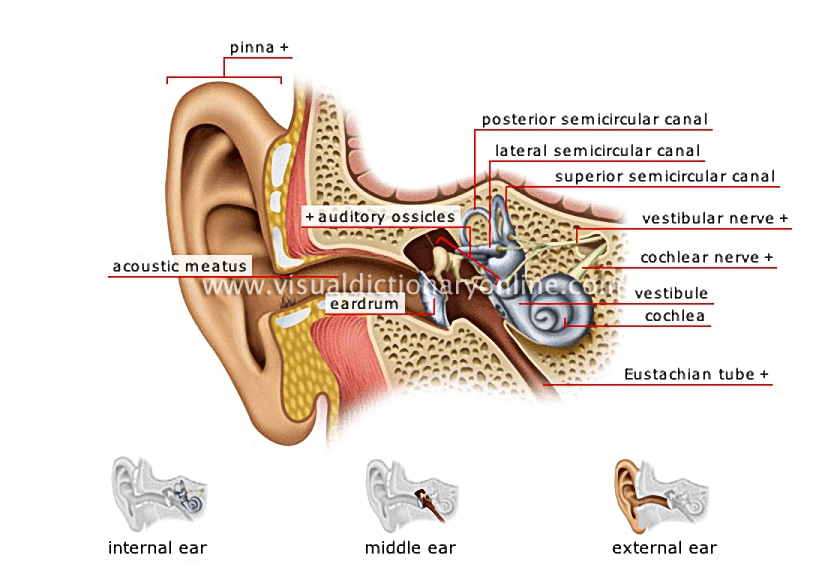
The ear is made up of three distinct parts; hearing is controlled by the inner ear, which contains the sensory organs.
structure of the ear 						Slender resistant elastic membrane; it vibrates when sound waves are received from the auditory canal, then transmits the waves to the ossicles.				  							Tube connecting the middle ear to the nasopharynx; it allows outside air to pass through, thus equalizing air pressure on both sides of the eardrum.												Bony structure into which the three semicircular canals open; with these canals, it is responsible for equilibrium.				  							Bony structure intended for hearing; it receives vibrations from the ossicles and transforms them into nervous impulses before transmitting them to the brain.				  							Horizontal canal; it monitors head movements to ensure that equilibrium is maintained.				  							Nerve transmitting auditory messages collected in the cochlea to the brain. The cochlear and vestibular nerves join to form the auditory nerve.				  							Nerve transmitting messages related to equilibrium to the brain; it emanates from the vestibule and the semicircular canals.				  							Vertical canal perpendicular to the temporal bone; it monitors head movements to ensure that equilibrium is maintained.				  							The smallest bones in the human body, held in place by several muscles and ligaments; they amplify the vibrations of the eardrum.												Vertical canal parallel to the temporal bone; it monitors head movements to ensure that equilibrium is maintained.				  							Soft cartilaginous outer portion of the ear located at the side of the head; it allows sounds to be collected.												Canal carrying the sounds collected by the pinna to the eardrum. It is lined with hair and covered with cerumen, a waxy substance that retains dust particles.				  							Liquid-filled cavity hollowed out of the temporal bone that transforms sound vibrations into nerve influxes to be interpreted by the brain.				  							Air-filled cavity hollowed out of the temporal bone; it receives sounds from the external ear, amplifies them through the auricles and transmits them to the internal ear.				  							Visible portion of the ear enabling sounds to be collected and directed to the middle ear through the acoustic meatus.

See Also


nasal fossae

auditory ossicles

pinna

ear protection

ear protection

earplugs

safety earmuffs

eardrum

Slender resistant elastic membrane; it vibrates when sound waves are received from the auditory canal, then transmits the waves to the ossicles.

Eustachian tube

Tube connecting the middle ear to the nasopharynx; it allows outside air to pass through, thus equalizing air pressure on both sides of the eardrum.
nasal fossae
nasal fossae

vestibule

Bony structure into which the three semicircular canals open; with these canals, it is responsible for equilibrium.

cochlea

Bony structure intended for hearing; it receives vibrations from the ossicles and transforms them into nervous impulses before transmitting them to the brain.

lateral semicircular canal

Horizontal canal; it monitors head movements to ensure that equilibrium is maintained.

cochlear nerve

Nerve transmitting auditory messages collected in the cochlea to the brain. The cochlear and vestibular nerves join to form the auditory nerve.

vestibular nerve

Nerve transmitting messages related to equilibrium to the brain; it emanates from the vestibule and the semicircular canals.

superior semicircular canal

Vertical canal perpendicular to the temporal bone; it monitors head movements to ensure that equilibrium is maintained.

auditory ossicles

The smallest bones in the human body, held in place by several muscles and ligaments; they amplify the vibrations of the eardrum.
auditory ossicles
auditory ossicles

posterior semicircular canal

Vertical canal parallel to the temporal bone; it monitors head movements to ensure that equilibrium is maintained.

pinna

Soft cartilaginous outer portion of the ear located at the side of the head; it allows sounds to be collected.
pinna
pinna

acoustic meatus

Canal carrying the sounds collected by the pinna to the eardrum. It is lined with hair and covered with cerumen, a waxy substance that retains dust particles.

internal ear

Liquid-filled cavity hollowed out of the temporal bone that transforms sound vibrations into nerve influxes to be interpreted by the brain.

middle ear

Air-filled cavity hollowed out of the temporal bone; it receives sounds from the external ear, amplifies them through the auricles and transmits them to the internal ear.

external ear

Visible portion of the ear enabling sounds to be collected and directed to the middle ear through the acoustic meatus.