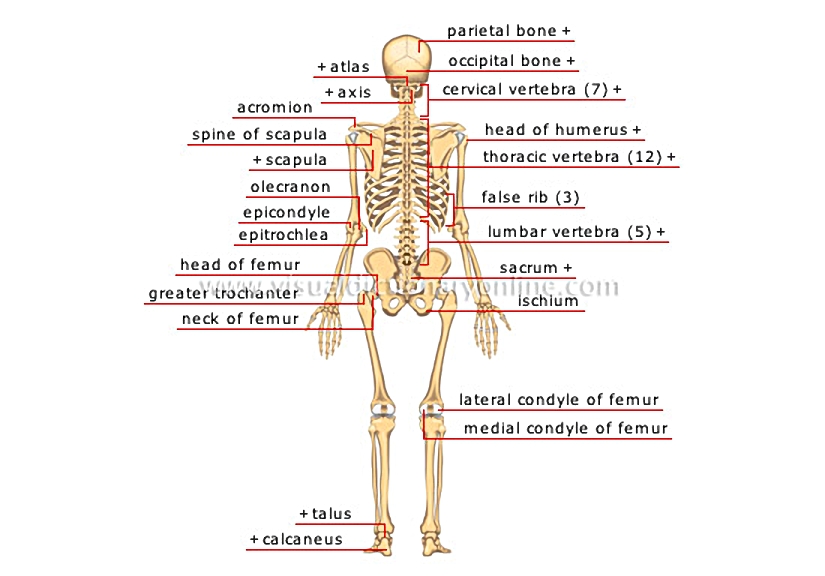
posterior view

posterior view 						Flat cranial bone articulating with the frontal, occipital, temporal and sphenoid bones; the two parietal bones form the largest portion of the dome of the skull.												Second cervical vertebra supporting the atlas; it allows the head to rotate.												Bony part of the neck forming the upper terminal part of the spinal column.												Upper terminal part of the humerus articulating very freely with the scapula.												Bony part supporting the ribs located between the cervical and lumbar vertebrae.												Slender curved bone articulated with the dorsal vertebrae at one end and attached to the upper rib at the other end.				  							Bony part larger than the other vertebrae located between the dorsal vertebrae and the sacrum; it supports a major portion of the body’s weight.												Bone made up of five fused vertebrae located between the lumbar and coccyx vertebrae.												Round protuberance of the lower terminal part of the femur enabling articulation with the tibia.				  							Round protuberance of the lower terminal part of the femur enabling articulation with the tibia; this condyle is longer and narrower than the lateral condyle.				  							Flat skull bone articulating with the parietal bone and atlas (first cervical vertebra), among others; it makes up the largest portion of the base of the skull.												First cervical vertebra supporting the head and supported by the axis.												Extension of the spine of the scapula forming the point of the shoulder and articulating with the clavicle.				  							Pointy protuberance of the posterior scapula that extends through the acromion.				  							Large thin flat bone articulating with the clavicle and the humerus to form the shoulder; numerous shoulder and back muscles are attached to it.				  							Outer protuberance of the lower terminal part of the humerus; various extensor muscles of the hand and fingers are attached to it.				  							Upper terminal part of the ulna articulating with the humerus; it forms the protuberance of the elbow.				  							Inner protuberance of the lower terminal part of the humerus; various flexor muscles of the hand and fingers are attached to it.				  							Large protuberance of the upper terminal part of the femur; various thigh and buttock muscles are attached to it.				  							Narrow portion of the femur connecting the head of the femur to the trochanters.				  							Upper terminal part of the femur articulating with the iliac bone to form the hip joint.				  							Constituent portion of the iliac bone supporting the body’s weight when seated.				  							Short bone of the tarsus that, with the calcaneus, ensures rotation of the ankle and, with the tibia and fibula, flexion and extension of the foot.												Large bone of the tarsus forming the protuberance of the heel; in the upright position, it is the posterior contact point of the plantar arch.
See Also


lateral view of skull

spinal column

shoulder

foot

parietal bone

Flat cranial bone articulating with the frontal, occipital, temporal and sphenoid bones; the two parietal bones form the largest portion of the dome of the skull.
lateral view of skull

axis

Second cervical vertebra supporting the atlas; it allows the head to rotate.
spinal column
spinal column

cervical vertebra (7)

Bony part of the neck forming the upper terminal part of the spinal column.
spinal column
spinal column

head of humerus

Upper terminal part of the humerus articulating very freely with the scapula.
shoulder
shoulder

thoracic vertebra (12)

Bony part supporting the ribs located between the cervical and lumbar vertebrae.
spinal column
spinal column

false rib (3)

Slender curved bone articulated with the dorsal vertebrae at one end and attached to the upper rib at the other end.

lumbar vertebra (5)

Bony part larger than the other vertebrae located between the dorsal vertebrae and the sacrum; it supports a major portion of the body’s weight.
spinal column
spinal column

sacrum

Bone made up of five fused vertebrae located between the lumbar and coccyx vertebrae.
spinal column
spinal column

lateral condyle of femur

Round protuberance of the lower terminal part of the femur enabling articulation with the tibia.

medial condyle of femur

Round protuberance of the lower terminal part of the femur enabling articulation with the tibia; this condyle is longer and narrower than the lateral condyle.

occipital bone

Flat skull bone articulating with the parietal bone and atlas (first cervical vertebra), among others; it makes up the largest portion of the base of the skull.
lateral view of skull

atlas

First cervical vertebra supporting the head and supported by the axis.
spinal column
spinal column

acromion

Extension of the spine of the scapula forming the point of the shoulder and articulating with the clavicle.

spine of scapula

Pointy protuberance of the posterior scapula that extends through the acromion.

scapula

Large thin flat bone articulating with the clavicle and the humerus to form the shoulder; numerous shoulder and back muscles are attached to it.

epicondyle

Outer protuberance of the lower terminal part of the humerus; various extensor muscles of the hand and fingers are attached to it.

olecranon

Upper terminal part of the ulna articulating with the humerus; it forms the protuberance of the elbow.

epitrochlea

Inner protuberance of the lower terminal part of the humerus; various flexor muscles of the hand and fingers are attached to it.

greater trochanter

Large protuberance of the upper terminal part of the femur; various thigh and buttock muscles are attached to it.

neck of femur

Narrow portion of the femur connecting the head of the femur to the trochanters.

head of femur

Upper terminal part of the femur articulating with the iliac bone to form the hip joint.

ischium

Constituent portion of the iliac bone supporting the body’s weight when seated.

talus

Short bone of the tarsus that, with the calcaneus, ensures rotation of the ankle and, with the tibia and fibula, flexion and extension of the foot.
foot
foot

calcaneus

Large bone of the tarsus forming the protuberance of the heel; in the upright position, it is the posterior contact point of the plantar arch.
foot
foot