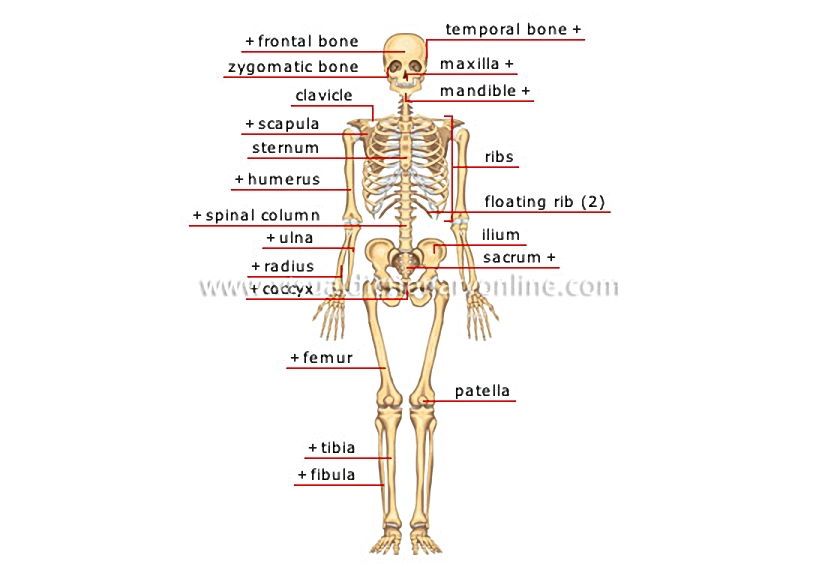
anterior view

anterior view 						Flat skull bone forming the forehead and top of the eye sockets, and articulating especially with the parietal.												Bone forming the cheek pouch and the outer edge of the eye socket.				  							Long inward-curving bone located between the acromion and the sternum.				  							Large thin flat bone articulating with the clavicle and the humerus to form the shoulder; numerous shoulder and back muscles are attached to it.												Long arm bone articulating with the scapula to form the shoulder, and with the radius and the ulna to form the elbow.												Long bone forming the inner portion of the forearm located between the humerus and the carpus (hand bone).												Long thigh bone articulating with the iliac bone, tibia and patella; it is the longest bone in the human body.												Long bone forming the inner portion of the leg located between the femur and the tarsus (foot bone).												Long bone forming the outer portion of the leg located between the femur and the tarsus (foot bone).												Flat skull bone that protects mainly the organs responsible for hearing and equilibrium.												Toothed bone forming the upper jaw; it helps to form the palate, eye sockets and nasal fossae.												Movable toothed bone forming the lower jaw; it is the only movable bone in the head and its articulation with the temporal bone allows the jaw to move.												Slender curved bones articulating with the dorsal vertebrae and the sternum; the 12 pairs of ribs make up the lateral walls of the thorax.				  							Long flat bone to which the ribs, in particular, are attached.				  							Thin curved bone articulating with the dorsal vertebrae at one end and remaining free at the other end.				  							Movable bony axis made up of various parts articulating with each other (vertebrae); it supports the skeleton and contains the spinal cord.												Large flat bone made up of three fused bones that attach the lower limb to the trunk; the ilium, sacrum and coccyx form the pelvis.				  							Bone made up of five fused vertebrae located between the lumbar and coccyx vertebrae.												Bone made up of four to six fused vertebrae in the lower terminal part of the vertebral column, and articulating with the sacrum.												Flat triangular slightly bulging and mobile bone articulating mainly with the femur; this knee bone allows the lower limb to flex and extend.				  							Long bone making up the outer section of the forearm; it is connected especially to the carpal bones to form the wrist joint.
See Also


lateral view of skull

shoulder

parts of a long bone

elbow

hand

structure of a long bone

leg

spinal column

wrist

frontal bone

Flat skull bone forming the forehead and top of the eye sockets, and articulating especially with the parietal.
lateral view of skull

zygomatic bone

Bone forming the cheek pouch and the outer edge of the eye socket.

clavicle

Long inward-curving bone located between the acromion and the sternum.

scapula

Large thin flat bone articulating with the clavicle and the humerus to form the shoulder; numerous shoulder and back muscles are attached to it.
shoulder
shoulder

humerus

Long arm bone articulating with the scapula to form the shoulder, and with the radius and the ulna to form the elbow.
parts of a long bone
shoulder
shoulder
elbow
elbow

ulna

Long bone forming the inner portion of the forearm located between the humerus and the carpus (hand bone).
hand
hand
elbow
elbow

femur

Long thigh bone articulating with the iliac bone, tibia and patella; it is the longest bone in the human body.
structure of a long bone

tibia

Long bone forming the inner portion of the leg located between the femur and the tarsus (foot bone).
leg
leg

fibula

Long bone forming the outer portion of the leg located between the femur and the tarsus (foot bone).
leg
leg

temporal bone

Flat skull bone that protects mainly the organs responsible for hearing and equilibrium.
lateral view of skull

maxilla

Toothed bone forming the upper jaw; it helps to form the palate, eye sockets and nasal fossae.
lateral view of skull

mandible

Movable toothed bone forming the lower jaw; it is the only movable bone in the head and its articulation with the temporal bone allows the jaw to move.
lateral view of skull

ribs

Slender curved bones articulating with the dorsal vertebrae and the sternum; the 12 pairs of ribs make up the lateral walls of the thorax.

sternum

Long flat bone to which the ribs, in particular, are attached.

floating rib (2)

Thin curved bone articulating with the dorsal vertebrae at one end and remaining free at the other end.

spinal column

Movable bony axis made up of various parts articulating with each other (vertebrae); it supports the skeleton and contains the spinal cord.
spinal column
spinal column

ilium

Large flat bone made up of three fused bones that attach the lower limb to the trunk; the ilium, sacrum and coccyx form the pelvis.

sacrum

Bone made up of five fused vertebrae located between the lumbar and coccyx vertebrae.
spinal column
spinal column

coccyx

Bone made up of four to six fused vertebrae in the lower terminal part of the vertebral column, and articulating with the sacrum.
spinal column
spinal column

patella

Flat triangular slightly bulging and mobile bone articulating mainly with the femur; this knee bone allows the lower limb to flex and extend.

radius

Long bone making up the outer section of the forearm; it is connected especially to the carpal bones to form the wrist joint.
elbow
elbow
wrist
wrist