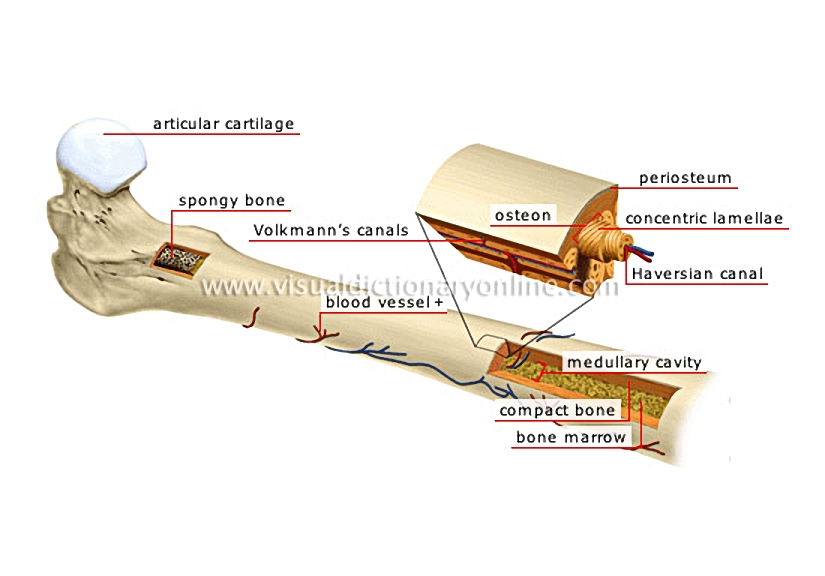
structure of a long bone
Long bone: elongated bone consisting of a body (diaphysis) and two terminal parts (epiphyses), such as the leg and arm bones (femur, radius, phalanges and others).
medullary cavity
Cylindrical central cavity of the bone containing the bone marrow; this canal encloses lipid-rich yellow bone marrow.
Haversian canal
Lengthwise central canal of the osteon enclosing blood vessels and nerves.
periosteum
Fibrous membrane rich in blood vessels that envelopes the bone, except at the articular surfaces; it contributes especially to the bone’s growth in thickness.
Volkmann’s canals
Transverse canals of the compact bone enclosing blood vessels and nerves; they connect the Haversian canals with each other and with the medullary cavity and the periosteum.
osteon
Elementary cylindrical structure of the compact bone made up of four to 20 concentric bone plates that surround the Haversian canal.
concentric lamellae
Bony layers of osteon made of collagen fibers; they are arranged concentrically around the Haversian canal and form as the bones grow.
articular cartilage
Smooth resistant elastic tissue covering the terminal part of the bone where it articulates with another bone; it facilitates movement and absorbs shocks.
spongy bone
Tissue made of bony compartments separated by cavities filled with bone marrow, blood vessels and nerves; this structure gives bones their lightness.
blood vessel
Channel in the bone through which the blood circulates, carrying the nutrients and mineral salts the bone requires.
compact bone
Dense bone tissue composed of osteons, which resist pressure and shocks and protect the spongy tissue; it forms especially the diaphysis of the long bones.
bone marrow
Soft substance contained in bone cavities, producing blood cells; marrow is red in children, yellow in the long bones of adults.
 previous

