turbofan engine

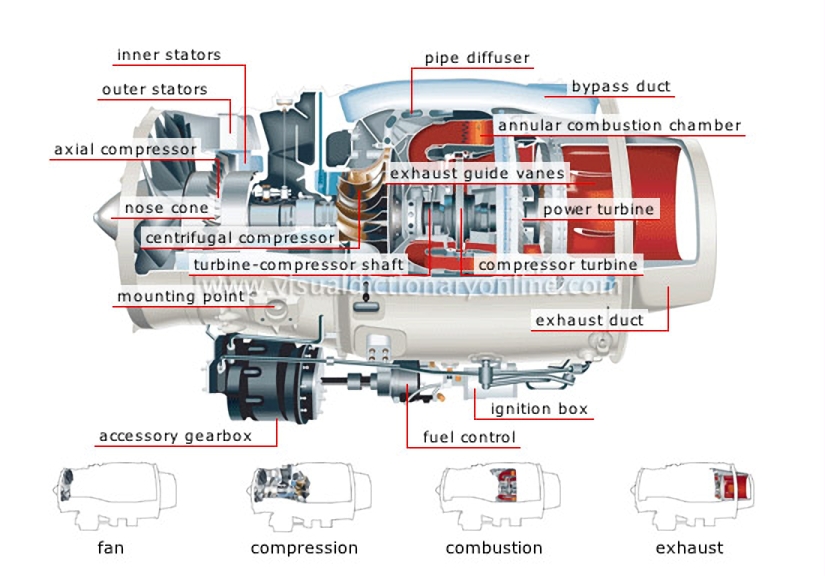
Jet engine with a fan and two airflows; one airflow passes through the combustion chamber and the other bypasses it.
turbofan engine 						Opening through which the exhaust gases are evacuated; the duct is usually cone-shaped in order to narrow the gas flow, thus increasing thrust.				  							Turbine that is driven by the gases expelled by the combustion chamber; it drives the axial compressor and the fan. It is independent of the compressor turbine.				  							Device that produces the electric pulses supplying the system that sets off combustion.				  							Turbine that is activated by the gas produced in the combustion chamber; it drives the centrifugal compressor and the accessories.				  							Device measuring the amount of fuel injected into the combustion chamber.				  							Mechanism that drives various accessories such as the alternator and the hydraulic, fuel and oil pumps.				  							Part where the engine is mounted on the aircraft.				  							Part located on the tip of the fan axle that creates an aerodynamic airflow into the fan blades.				  							Protruding parts directing the exhaust gases straight out.				  							Channel that conducts some of the air sucked in by the fan, which contributes to the engine’s thrust.				  							Enclosure consisting of two concentric hydraulic cylinders that surrounds the turbine-compressor shaft and where combustion occurs.				  							Axle transmitting the turbine’s rotational movement to the compressors.				  							Conduit with several exit orifices that connects the centrifugal compressor to the combustion chamber; its purpose is to direct the flow and slow down the airflow to increase its pressure.				  							Engine components that use centrifugal force to compress air and expel it at very high speed to the combustion chamber by the pipe diffuser.				  							Set of fixed blades that corrects the airflow that is deflected as it passes through the blades of the axial compressor.				  							Set of fixed blades that corrects the airflow that is deflected as it passes through the fan.				  							Engine component in which air is highly compressed by a set of small fan blades to increase the engine’s output and reduce fuel consumption.				  							Phase during which the air expands and produces a thrust that activates the turbines and propels the turbofan engine.				  							Phase during which the compressed air enters the combustion chamber, where it is mixed with fuel and ignited.				  							Phase during which some of the air flowing through the engine is compressed before it enters the combustion chamber.				  							Blower sucking air into the turbofan engine.

See Also


long-range jet

exhaust duct

Opening through which the exhaust gases are evacuated; the duct is usually cone-shaped in order to narrow the gas flow, thus increasing thrust.

power turbine

Turbine that is driven by the gases expelled by the combustion chamber; it drives the axial compressor and the fan. It is independent of the compressor turbine.

ignition box

Device that produces the electric pulses supplying the system that sets off combustion.

compressor turbine

Turbine that is activated by the gas produced in the combustion chamber; it drives the centrifugal compressor and the accessories.

fuel control

Device measuring the amount of fuel injected into the combustion chamber.

accessory gearbox

Mechanism that drives various accessories such as the alternator and the hydraulic, fuel and oil pumps.

mounting point

Part where the engine is mounted on the aircraft.

nose cone

Part located on the tip of the fan axle that creates an aerodynamic airflow into the fan blades.

exhaust guide vanes

Protruding parts directing the exhaust gases straight out.

bypass duct

Channel that conducts some of the air sucked in by the fan, which contributes to the engine’s thrust.

annular combustion chamber

Enclosure consisting of two concentric hydraulic cylinders that surrounds the turbine-compressor shaft and where combustion occurs.

turbine-compressor shaft

Axle transmitting the turbine’s rotational movement to the compressors.

pipe diffuser

Conduit with several exit orifices that connects the centrifugal compressor to the combustion chamber; its purpose is to direct the flow and slow down the airflow to increase its pressure.

centrifugal compressor

Engine components that use centrifugal force to compress air and expel it at very high speed to the combustion chamber by the pipe diffuser.

inner stators

Set of fixed blades that corrects the airflow that is deflected as it passes through the blades of the axial compressor.

outer stators

Set of fixed blades that corrects the airflow that is deflected as it passes through the fan.

axial compressor

Engine component in which air is highly compressed by a set of small fan blades to increase the engine’s output and reduce fuel consumption.

exhaust

Phase during which the air expands and produces a thrust that activates the turbines and propels the turbofan engine.

combustion

Phase during which the compressed air enters the combustion chamber, where it is mixed with fuel and ignited.

compression

Phase during which some of the air flowing through the engine is compressed before it enters the combustion chamber.
fan

Blower sucking air into the turbofan engine.