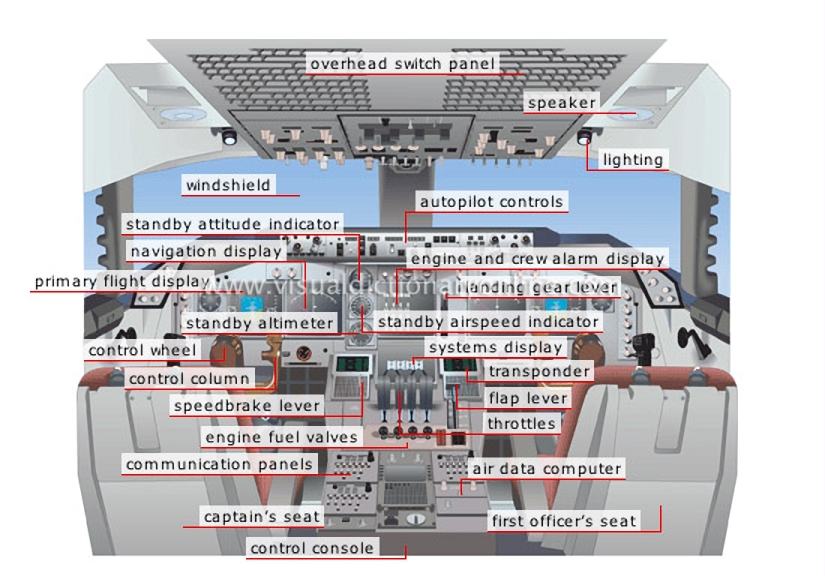
flight deck
Compartment that contains navigation equipment and controls and from which the crew pilots the aircraft.
air data computer
Computer that calculates the flight parameters (speed, altitude and course).
transponder
Instruments that, with the autopilot, control the engine power and guide the aircraft on its course.
first officer’s seat
Right seat occupied by the copilot, who is second in command.
flap lever
Control stick that activates the wing slats and the trailing edge flaps.
control console
Component located between the two seats that contains part of the instrumentation.
engine fuel valves
Knobs for opening and shutting the fuel supply to the engines.
communication panels
Panel for selecting radio frequencies on which pilots can send or receive.
captain’s seat
Left seat occupied by the pilot, who is in charge of the flight and the crew.
systems display
Screen that controls various systems, such as air pressure and the electric and hydraulic circuits.
speedbrake lever
Command stick that releases the wing flaps to brake the aircraft immediately after landing.
control wheel
Lever that activates the control column from back to front and from side to side.
control column
Steering component that causes an aircraft to bank to the left or to the right and to ascend or descend.
primary flight display
Screen that shows the main parameters necessary for piloting (aircraft’s position in relation to the horizon, altitude and course).
navigation display
Screen that shows the aircraft’s position and flight plan and weather conditions.
standby altimeter
Instrument that shows the vertical distance between the aircraft and the ground; it is used in the event the flight display fails.
standby airspeed indicator
Instrument that shows the aircraft’s speed; it is used in the event the flight display fails.
standby attitude indicator
Screen that shows the aircraft’s position in relation to the horizon; it is used in the event the flight display fails.
windshield
Highly durable pane made of glass and plastic that provides good visibility.
engine and crew alarm display
Screen that controls the engines and displays alarm signals in the event of system failure.
autopilot controls
Device that enables the aircraft to be piloted and kept on course automatically.
overhead switch panel
Panel made up of the switches that cut the hydraulic, electric and fuel circuits.
lighting
Device that diffuses light over a shelf on which the pilots place navigation charts.
speaker
Integrated device that relays audible messages such as alarms to the pilots.
 previous