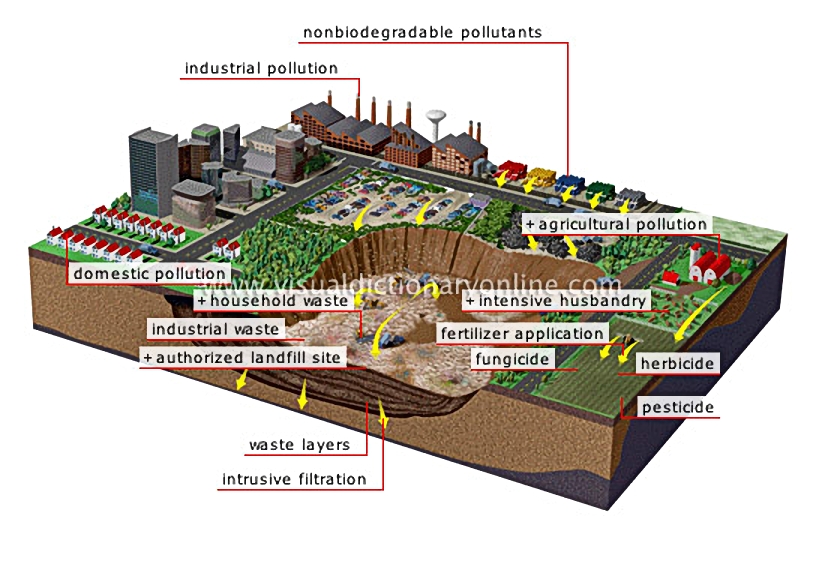
land pollution
Numerous factors contribute to soil pollution (e.g., household and industrial waste, fertilizers, pesticides).
intensive husbandry
Animal dung introduces large quantities of nitrate into the soil; the nitrate then filters into the water table.
nonbiodegradable pollutants
Products that cannot be completely decomposed by living organisms.
industrial pollution
Most nonbiodegradable soil pollutants are produced by industry, which discharges more than 700 different substances.
domestic pollution
Pollution generated by an increase in household waste and detergent spilled into wastewater.
industrial waste
Some of it is treated in the same manner as household waste, while other forms containing toxic substances are processed at specialized sites.
household waste
It is composed mostly of biodegradable organic matter but also contains plastics, detergents, solvents and heavy metals.
authorized landfill site
Land that is filled with household and industrial waste and then covered with successive layers of earth.
waste layers
Each waste layer is sealed using a plastic film or a base layer of clay.
intrusive filtration
In spite of the sealing of waste layers, rainwater runoff allows certain pollutants to seep into the subsoil.
pesticide
Product (insecticide, herbicide or fungicide) that destroys harmful organisms. It sometimes enters the food chain and affects flora and fauna.
herbicide
It is used to destroy or limit the growth of plants harmful to crops.
fertilizer application
The excessive use of fertilizers leads to an increased quantity of mineral compounds in the soil and in farmed crops.
agricultural pollution
It has developed with the intensification of agriculture and the large-scale use of fertilizers and pesticides.
 previous

