air pollution

The presence in the atmosphere of large quantities of particles or gases produced by human activity; these are harmful to both animal and plant life.
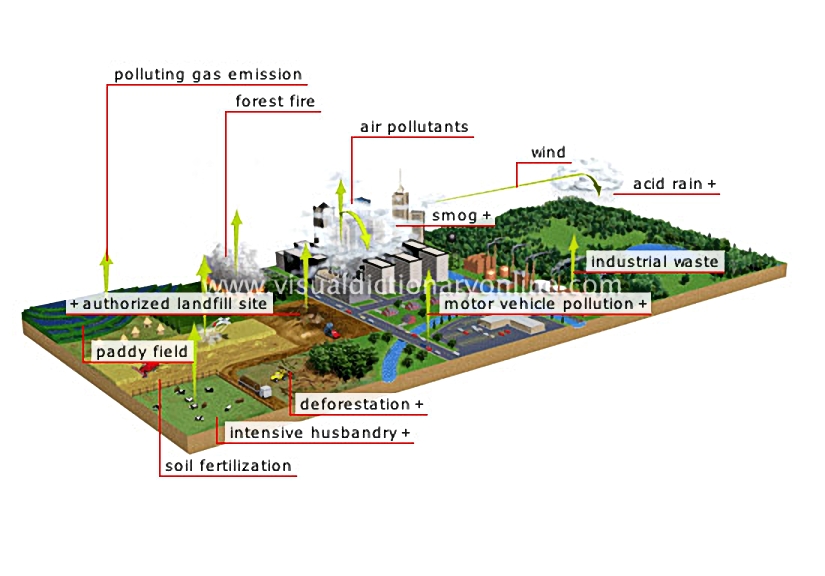
air pollution 						Paddy fields release considerable quantities of methane.				  							Nitrogen fertilizers used to fertilize the soil also release nitrogen oxides.				  							Bacteria involved in the digestion of ruminants also trigger the emission of methane into the air.												Large-scale deforestation leads to increased carbon dioxide levels in the atmosphere since plants alone absorb and retain this gas.												Motor vehicle exhaust contains carbon particles, nitrogen oxides, sulfur dioxide and hydrocarbons.				  							Depending on their activity, industries emit a great variety of pollutants such as nitrogen oxides, sulfur dioxide, ozone, heavy metals and hydrocarbons.				  							Rain that contains an unusually high concentration of sulfuric acid and nitric acid.												Polluted clouds are carried by the wind, sometimes traveling thousands of miles; their pollutants then fall in the form of acid rain.				  							Harmful haze resulting from the presence of polluting gases; it forms over cities under specific meteorological conditions.												The principal air pollutants are sulfur dioxide, nitrogen oxides, hydrocarbons, methane and carbon dioxide.				  							Forest fires and brush fires release carbon monoxide, methane and nitrogen oxides.				  							In waste landfill sites, decomposing organic matter produces methane.												Most polluting gases are present in the atmosphere in minuscule quantities, but human activity increases their concentration.
See Also


farmstead

conifer

vegetation regions

acid rain

metropolitan area?[1]

land pollution

photosynthesis

enhanced greenhouse effect

paddy field

Paddy fields release considerable quantities of methane.

soil fertilization

Nitrogen fertilizers used to fertilize the soil also release nitrogen oxides.

intensive husbandry

Bacteria involved in the digestion of ruminants also trigger the emission of methane into the air.
farmstead
farmstead

deforestation

Large-scale deforestation leads to increased carbon dioxide levels in the atmosphere since plants alone absorb and retain this gas.
conifer
conifer
vegetation regions
vegetation regions

motor vehicle pollution

Motor vehicle exhaust contains carbon particles, nitrogen oxides, sulfur dioxide and hydrocarbons.

industrial waste

Depending on their activity, industries emit a great variety of pollutants such as nitrogen oxides, sulfur dioxide, ozone, heavy metals and hydrocarbons.

acid rain

Rain that contains an unusually high concentration of sulfuric acid and nitric acid.
acid rain
acid rain

wind

Polluted clouds are carried by the wind, sometimes traveling thousands of miles; their pollutants then fall in the form of acid rain.

smog

Harmful haze resulting from the presence of polluting gases; it forms over cities under specific meteorological conditions.
metropolitan area [1]

air pollutants

The principal air pollutants are sulfur dioxide, nitrogen oxides, hydrocarbons, methane and carbon dioxide.

forest fire

Forest fires and brush fires release carbon monoxide, methane and nitrogen oxides.

authorized landfill site

In waste landfill sites, decomposing organic matter produces methane.
land pollution
land pollution

polluting gas emission

Most polluting gases are present in the atmosphere in minuscule quantities, but human activity increases their concentration.