international space station

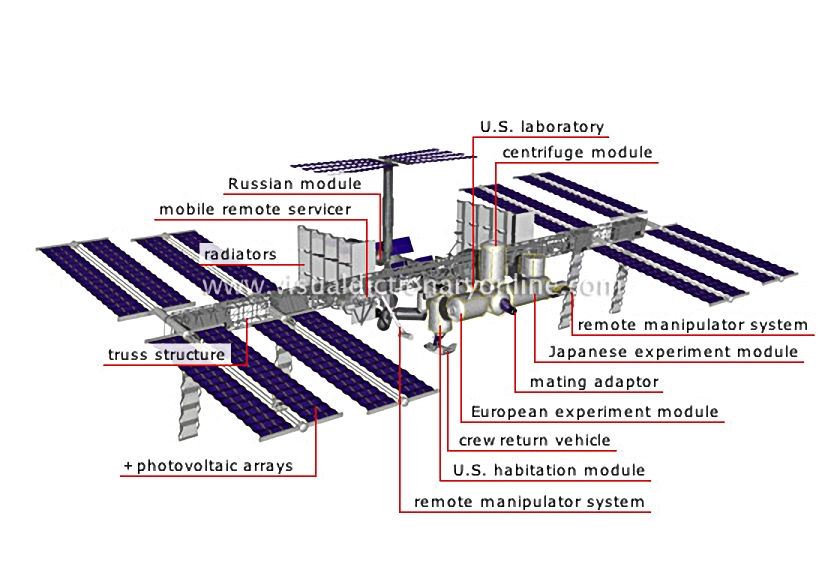
Complex made up of some 10 modules in orbit around Earth; built and assembled by 15 countries, it is used to conduct scientific and technological research on weightlessness.
international space station 						Base that supports the arm and allows it to move about the structure.				  							Vehicle used to bring the crew back to Earth in case of emergency.				  							This mechanical arm is used to lift heavy loads during the assembly of the station and to perform maintenance work.				  							Generates the station’s electrical energy using photovoltaic cells.				  							Panels that supply power to the station by transforming the Sun’s light into electrical current.												Designed to accommodate six persons; contains a kitchen, roomettes, a bathroom and first-aid equipment.				  							Corrugated panels ensuring heat evacuation from the station.				  							Truss frame attached to the U.S. laboratory.				  							Designed to carry out scientific activities, particularly in the life sciences and in physics.				  							Mechanical arm designed to conduct scientific experiments on the Japanese platform.				  							Module used to create variable artificial gravity, making it possible to study the effect of gravity levels on living organisms.				  							Designed to conduct research in the life and materials sciences, in physics and in numerous other technologies.				  							Connector on which the space shuttle orbiter docks during most of the station’s supply and assembly missions.				  							Designed to conduct research in the life sciences and in the science of matter; also equipped with a platform for outside experiments.
See Also


structure of the Sun?[1]

spacesuit

mobile remote servicer

Base that supports the arm and allows it to move about the structure.

crew return vehicle

Vehicle used to bring the crew back to Earth in case of emergency.

remote manipulator system

This mechanical arm is used to lift heavy loads during the assembly of the station and to perform maintenance work.

Russian module

Generates the station’s electrical energy using photovoltaic cells.

photovoltaic arrays

Panels that supply power to the station by transforming the Sun’s light into electrical current.
structure of the Sun [1]

U.S. habitation module

Designed to accommodate six persons; contains a kitchen, roomettes, a bathroom and first-aid equipment.

radiators

Corrugated panels ensuring heat evacuation from the station.

truss structure

Truss frame attached to the U.S. laboratory.

U.S. laboratory

Designed to carry out scientific activities, particularly in the life sciences and in physics.

remote manipulator system

Mechanical arm designed to conduct scientific experiments on the Japanese platform.

centrifuge module

Module used to create variable artificial gravity, making it possible to study the effect of gravity levels on living organisms.

European experiment module

Designed to conduct research in the life and materials sciences, in physics and in numerous other technologies.

mating adaptor

Connector on which the space shuttle orbiter docks during most of the station’s supply and assembly missions.

Japanese experiment module

Designed to conduct research in the life sciences and in the science of matter; also equipped with a platform for outside experiments.