morphology of a perch

Perch: bony carnivorous freshwater fish with an oval body and a spiny dorsal fin; its flesh is highly prized.
morphology of a perch 						Each of the small thin hard plates overlapping one another to cover the fish’s body.				  							Swimming appendage formed of a membrane and rays located on the middle ventral portion of the body behind the anus; it provides stability.				  							Powerful swimming appendage with two lobes formed of a membrane and rays located vertically at the posterior terminal part of the body; its function is propulsion.				  							Subcutaneous canal protruding from the body and head formed of organs that are sensitive to vibrations in the water; it detects and locates objects and animals.				  							Long Y-shaped flexible part supporting the membrane of the second dorsal fin.				  							Swimming appendage formed of a membrane and rays located on the ventral surface of the body; it helps especially in maintaining equilibrium.				  							Swimming appendage made of bone that ensures stability, orientation, stopping and thermoregulation.				  							Thin bony plate of skin covering the gills and having a posterior valvular opening, the hearing organ.				  							Toothed bone forming, with the premaxilla, the upper jaw.				  							Toothed bone forming the lower jaw.				  							External orifice of the nasal cavity located above the mouth with a highly developed olfactory function.				  							Bone forming the anterior portion of the upper jaw.				  							Hard sharp part supporting the membrane of the first dorsal fin.

See Also


bony fishes?[1]

scale

Each of the small thin hard plates overlapping one another to cover the fish’s body.

anal fin

Swimming appendage formed of a membrane and rays located on the middle ventral portion of the body behind the anus; it provides stability.

caudal fin

Powerful swimming appendage with two lobes formed of a membrane and rays located vertically at the posterior terminal part of the body; its function is propulsion.

lateral line

Subcutaneous canal protruding from the body and head formed of organs that are sensitive to vibrations in the water; it detects and locates objects and animals.

soft ray

Long Y-shaped flexible part supporting the membrane of the second dorsal fin.

pelvic fin

Swimming appendage formed of a membrane and rays located on the ventral surface of the body; it helps especially in maintaining equilibrium.

pectoral fin

Swimming appendage made of bone that ensures stability, orientation, stopping and thermoregulation.

operculum

Thin bony plate of skin covering the gills and having a posterior valvular opening, the hearing organ.

maxilla

Toothed bone forming, with the premaxilla, the upper jaw.

mandible

Toothed bone forming the lower jaw.

nostril

External orifice of the nasal cavity located above the mouth with a highly developed olfactory function.
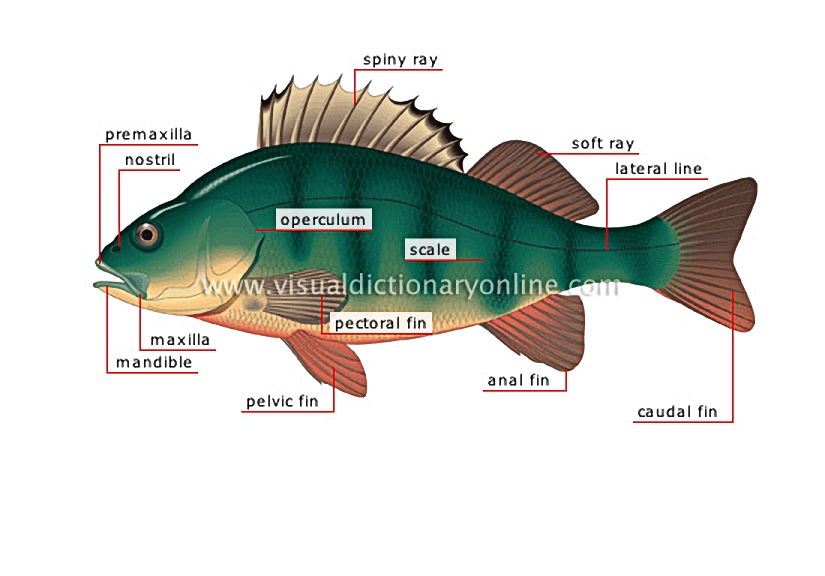
premaxilla

Bone forming the anterior portion of the upper jaw.

spiny ray

Hard sharp part supporting the membrane of the first dorsal fin.