cartilaginous fish
Fish whose skeleton is made of cartilage rather than bone; its skin is covered in hard scales called denticles. There are currently 700 species.
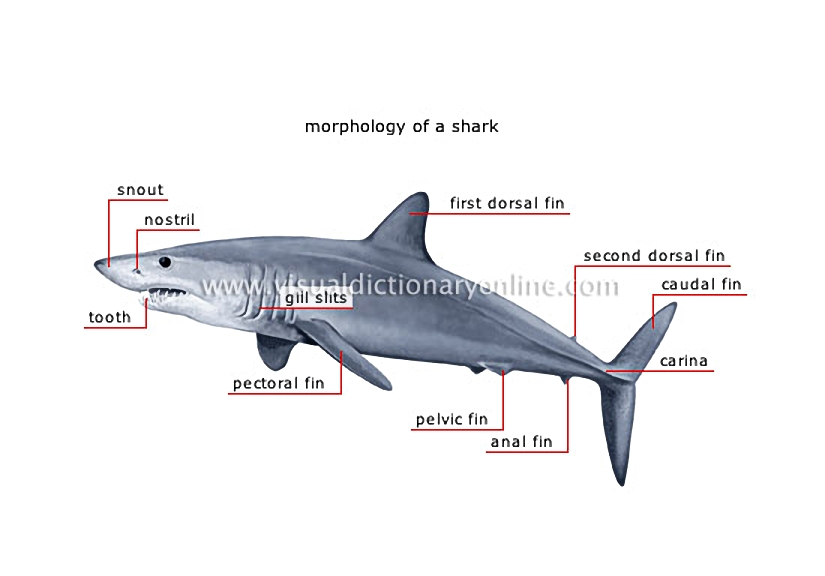
morphology of a shark
Shark: large cartilaginous carnivorous fish with a tapered body and extremely powerful toothed jaws; it rarely attacks humans.
pelvic fin
Swimming appendage formed of firm cartilage located on the ventral surface of the body; it helps especially in maintaining equilibrium.
anal fin
Swimming appendage formed of firm cartilage located on the middle ventral portion of the body behind the anus; it provides stability.
first dorsal fin
Swimming appendage, also called a flipper, made of firm cartilage located midway between the head and the tail; it provides stability.
nostril
External orifice of the nasal cavity located above the mouth with a highly developed olfactory function.
caudal fin
Powerful swimming appendage with two lobes formed of firm cartilage located vertically at the posterior terminal part of the body; its function is propulsion.
carina
Protruding median line of the posterior side portion of the body that reinforces the base of the caudal fin.
second dorsal fin
Swimming appendage formed of firm cartilage located on the middle posterior dorsal portion of the body; it provides stability.
gill slits
Respiratory organs (five pairs) shaped like long narrows channels between the buccal cavity and the outside of the body; the shark uses them to circulate water.
tooth
Hard organ arranged in several rows along the jaws and continually renewing itself; the teeth are used to catch prey and tear it apart.
pectoral fin
Swimming appendage made of firm cartilage that ensures stability, orientation, stopping and thermoregulation.
snout
Pointy anterior protruding portion of the head located above the mouth and bearing the nostrils on each side.
 previous
