anatomy of a perch

Perch: snub-nosed bony freshwater fish with an oval body and a spiny dorsal fin; the flesh of this fish is highly valued.
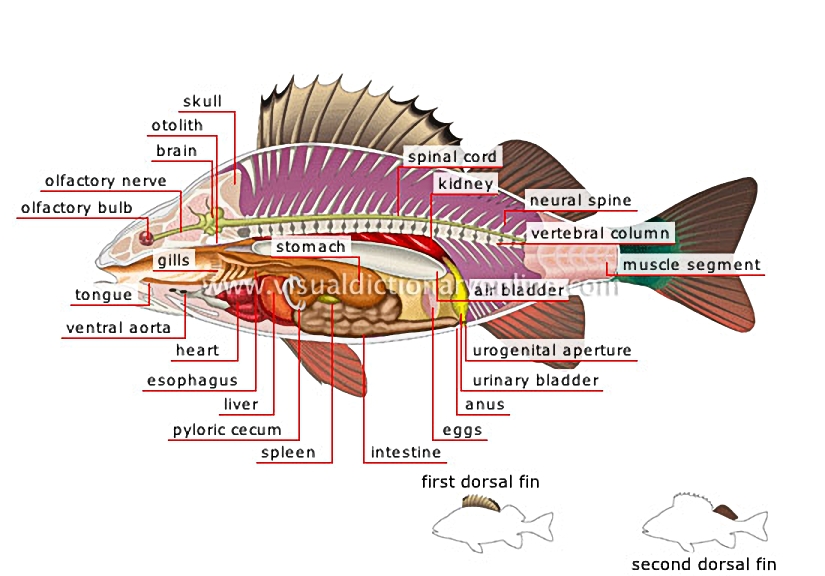
anatomy of a perch 						Muscular segment of the posterior portion of the body; its zigzag arrangement contributes to efficient motion.				  							Bony structure enclosing and protecting the brain.				  							Opening common to the genital and urinary tracts allowing the evacuation of gametes and urine.				  							Flexible air-filled sac located above the viscera; it allows the fish to remain buoyant at a specific depth.				  							Movable bony axis made up of various parts articulating with each other (vertebrae); it supports the skeleton and contains the spinal cord.				  							Component of the nervous system made up of a soft fatty substance and forming a cylindrical stem inside the vertebral column.				  							Bony stem of the nervous system connected to the vertebral column and forming the skeleton.				  							Organ that eliminates metabolic waste and maintains the pressure of internal fluids.				  							Section of the digestive tract between the stomach and the anus where absorption of nutrients is carried out and waste is transformed into fecal matter.				  							Dilated section of the digestive tract preceding the intestine; it receives food to be digested.				  							Lateral canal of the digestive tract where a part of digestion mainly occurs, as well as fermentation.				  							Canal of the anterior portion of the digestive tract; it carries food to the stomach.				  							Muscular organ helping blood to circulate.				  							Canal circulating the blood from the heart to the gills, then on through the head and the rest of the body.				  							Respiratory and excretory organs (four pairs) each formed of two layers of filaments; they enable water to exchange oxygen and ammonium as it circulates over the gills.				  							Elongated movable mouthpart having a gustatory function; it allows the fish to swallow its food.				  							Enlargement of the anterior terminal end of the olfactory nerve where its roots come together.				  							Cranial cord connecting the brain to the olfactory bulb.				  							Main organ of the nervous system that is made up of nerve centers; it is located in the upper portion of the head and is protected by the skull.				  							Small calcareous structure of the inner ear ensuring the fish’s equilibrium in the water.				  							Reservoir in which urine from the kidneys collects before being evacuated through the urogenital aperture.				  							Viscera that secretes bile, among other substances; bile helps digestion.				  							Organ of the circulatory system where impurities in the blood are destroyed.				  							Terminal orifice of the digestive tract enabling ejection of fecal matter.				  							In fish, the female produces eggs in the ovaries and the male produces soft roe in the testicles; the eggs and roe are expelled into the water, where fertilization occurs.				  							Swimming appendage formed of a membrane and usually prickly rays located on the middle anterior dorsal portion of the body; it provides stability.				  							Swimming appendage formed of a membrane and rays located on the middle posterior dorsal portion of the body; it provides stability.
See Also


bony fishes?[1]

muscle segment

Muscular segment of the posterior portion of the body; its zigzag arrangement contributes to efficient motion.

skull

Bony structure enclosing and protecting the brain.

urogenital aperture

Opening common to the genital and urinary tracts allowing the evacuation of gametes and urine.

air bladder

Flexible air-filled sac located above the viscera; it allows the fish to remain buoyant at a specific depth.

vertebral column

Movable bony axis made up of various parts articulating with each other (vertebrae); it supports the skeleton and contains the spinal cord.

spinal cord

Component of the nervous system made up of a soft fatty substance and forming a cylindrical stem inside the vertebral column.

neural spine

Bony stem of the nervous system connected to the vertebral column and forming the skeleton.

kidney

Organ that eliminates metabolic waste and maintains the pressure of internal fluids.

intestine

Section of the digestive tract between the stomach and the anus where absorption of nutrients is carried out and waste is transformed into fecal matter.

stomach

Dilated section of the digestive tract preceding the intestine; it receives food to be digested.

pyloric cecum

Lateral canal of the digestive tract where a part of digestion mainly occurs, as well as fermentation.

esophagus

Canal of the anterior portion of the digestive tract; it carries food to the stomach.

heart

Muscular organ helping blood to circulate.

ventral aorta

Canal circulating the blood from the heart to the gills, then on through the head and the rest of the body.

gills

Respiratory and excretory organs (four pairs) each formed of two layers of filaments; they enable water to exchange oxygen and ammonium as it circulates over the gills.

tongue

Elongated movable mouthpart having a gustatory function; it allows the fish to swallow its food.

olfactory bulb

Enlargement of the anterior terminal end of the olfactory nerve where its roots come together.

olfactory nerve

Cranial cord connecting the brain to the olfactory bulb.

brain

Main organ of the nervous system that is made up of nerve centers; it is located in the upper portion of the head and is protected by the skull.

otolith

Small calcareous structure of the inner ear ensuring the fish’s equilibrium in the water.

urinary bladder

Reservoir in which urine from the kidneys collects before being evacuated through the urogenital aperture.

liver

Viscera that secretes bile, among other substances; bile helps digestion.

spleen

Organ of the circulatory system where impurities in the blood are destroyed.

anus

Terminal orifice of the digestive tract enabling ejection of fecal matter.

eggs

In fish, the female produces eggs in the ovaries and the male produces soft roe in the testicles; the eggs and roe are expelled into the water, where fertilization occurs.

first dorsal fin

Swimming appendage formed of a membrane and usually prickly rays located on the middle anterior dorsal portion of the body; it provides stability.

second dorsal fin

Swimming appendage formed of a membrane and rays located on the middle posterior dorsal portion of the body; it provides stability.