morphology of a frog

morphology of a frog 						Long powerful articulated member attached to the terminal end of the trunk; it has five webbed toes used for walking, jumping and swimming.				  							Each of the digits of the foot, connected by membranes; when spread, they make swimming easier.				  							Fine membrane of skin connecting the digits of the foot; it stretches when the frog swims.				  							Terminal end of the limbs formed of various articulated bones; it has neither nails nor claws.				  							Short articulated member located behind the head; it has four digits and is used for walking.				  							Thin muscular membrane that is translucent and movable; it rises from the lower edge of the eye to protect and cleanse it.				  							Anterior cavity of the digestive tract located on the ventral surface that allows food to be ingested.				  							External orifice of the nasal cavity located above the mouth and having olfactory and respiratory functions.				  							Anterior round protruding portion of the head that forms the mouth and the nostrils.				  							Protruding organ of sight contained in the bony cavity at the top of the head used to perceive light intensity, motion and shapes.				  							Thin strong elastic membrane connected to the inner ear to capture acoustic vibrations.				  							Thick fixed membrane.				  							Bony portion of the body to which the head and limbs are attached.

See Also


examples of amphibians?[1]

hind limb

Long powerful articulated member attached to the terminal end of the trunk; it has five webbed toes used for walking, jumping and swimming.

webbed foot

Each of the digits of the foot, connected by membranes; when spread, they make swimming easier.

web

Fine membrane of skin connecting the digits of the foot; it stretches when the frog swims.

digit

Terminal end of the limbs formed of various articulated bones; it has neither nails nor claws.

forelimb

Short articulated member located behind the head; it has four digits and is used for walking.

lower eyelid

Thin muscular membrane that is translucent and movable; it rises from the lower edge of the eye to protect and cleanse it.

mouth

Anterior cavity of the digestive tract located on the ventral surface that allows food to be ingested.

nostril

External orifice of the nasal cavity located above the mouth and having olfactory and respiratory functions.

snout

Anterior round protruding portion of the head that forms the mouth and the nostrils.

eyeball

Protruding organ of sight contained in the bony cavity at the top of the head used to perceive light intensity, motion and shapes.

tympanum

Thin strong elastic membrane connected to the inner ear to capture acoustic vibrations.
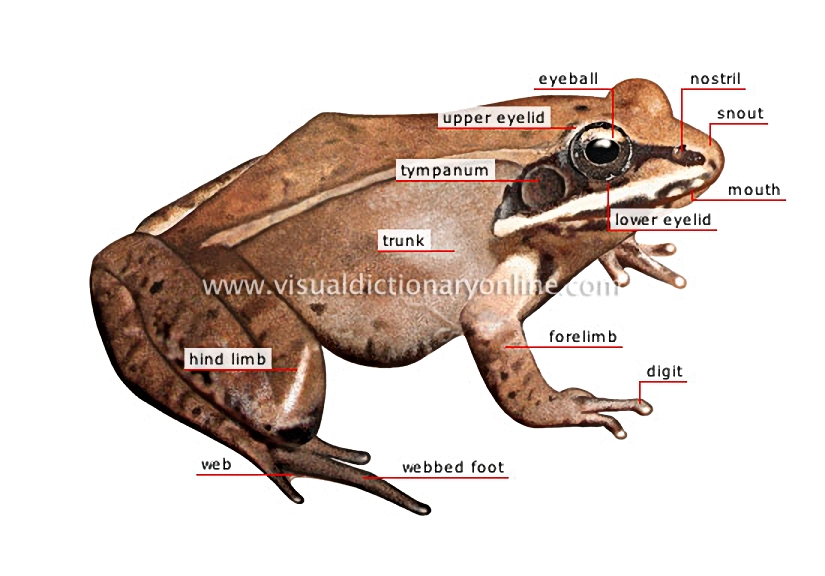
upper eyelid

Thick fixed membrane.

trunk

Bony portion of the body to which the head and limbs are attached.