skeleton of a bird

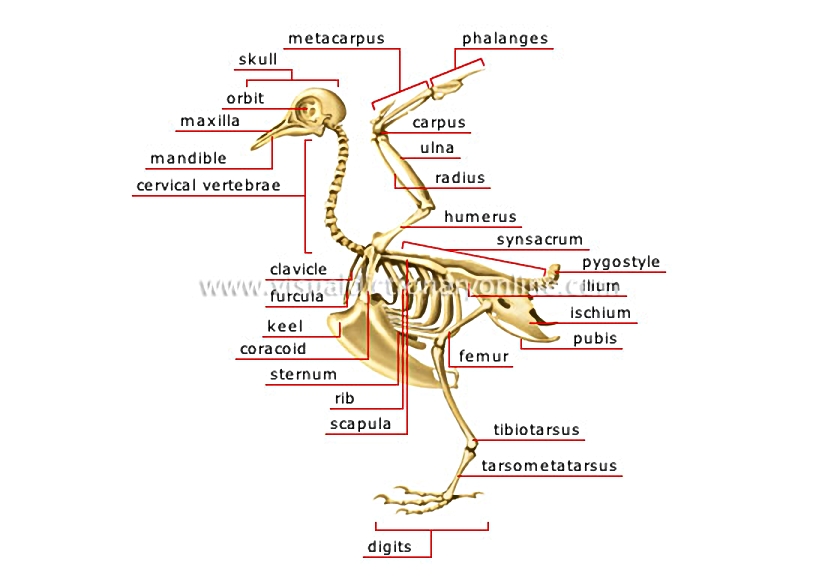
skeleton of a bird 						Bone resulting from the fusion of the lower portion of the two clavicles enabling the wings to spread.				  							Portion of the wing formed of articulated bones bearing the primaries.				  							Portion of the wing formed of three long bones; it connects the carpus to the first phalanges of the digits.				  							Portion of the wing formed of two short bones; it is located between the radius, the ulna and the metacarpus.				  							Long sturdy bone located between the humerus and the carpus bearing the secondaries.				  							Long wing bone located between the humerus and the carpus.				  							Long wing bone articulating especially with the radius and the ulna and bearing the tertials.				  							Long bone resulting from the fusion of numerous vertebrae of the vertebral column, preceding the pygostyle.				  							Bone of the terminal end of the vertebral column resulting from the fusion of several vertebrae.				  							Ventral bone posterior to the ilium.				  							Bone behind the ilium; the ilium, ischium and pubis fuse together to form a single bone to which the leg is attached.				  							Large flat back bone fused mainly to the synsacrum.				  							Long bone articulating especially with the tibiotarsus.				  							Separate at the crown, the tibia and fibula fuse into a single bone to form the tibiotarsus.				  							Bone formed by the fusion of the anterior portion of the tarsus and the metatarsus; the digits articulate with it. It is also called the tarsus.				  							Each of the four terminal ends of the legs formed of different articulated bones called phalanges; most birds have four digits.				  							Bone located at the ventral portion of the body and bearing the keel; the ribs are attached to it.				  							Bony ridge of the ventral surface of the sternum providing a solid support for the flight muscles.				  							Thin curved bone articulating with the vertebral column and the sternum.				  							Ventral bone connecting the scapula to the sternum.				  							Long bone located in the anterior ventral portion of the body; the two clavicles fuse to form the furcula.				  							Large flat back bone. The juncture point of the scapula, clavicle and coracoid; the wing is attached to it.				  							Bony parts of the neck comprising the upper terminal end of the vertebral column.				  							Bone forming the lower portion of the bill.				  							Bone forming the upper portion of the bill.				  							Bony cavity of the upper lateral potion of the head containing the eye.				  							Bony structure enclosing and protecting the brain.
See Also


examples of birds?[1]

furcula

Bone resulting from the fusion of the lower portion of the two clavicles enabling the wings to spread.

phalanges

Portion of the wing formed of articulated bones bearing the primaries.

metacarpus

Portion of the wing formed of three long bones; it connects the carpus to the first phalanges of the digits.

carpus

Portion of the wing formed of two short bones; it is located between the radius, the ulna and the metacarpus.

ulna

Long sturdy bone located between the humerus and the carpus bearing the secondaries.

radius

Long wing bone located between the humerus and the carpus.

humerus

Long wing bone articulating especially with the radius and the ulna and bearing the tertials.

synsacrum

Long bone resulting from the fusion of numerous vertebrae of the vertebral column, preceding the pygostyle.

pygostyle

Bone of the terminal end of the vertebral column resulting from the fusion of several vertebrae.

pubis

Ventral bone posterior to the ilium.

ischium

Bone behind the ilium; the ilium, ischium and pubis fuse together to form a single bone to which the leg is attached.

ilium

Large flat back bone fused mainly to the synsacrum.

femur

Long bone articulating especially with the tibiotarsus.

tibiotarsus

Separate at the crown, the tibia and fibula fuse into a single bone to form the tibiotarsus.

tarsometatarsus

Bone formed by the fusion of the anterior portion of the tarsus and the metatarsus; the digits articulate with it. It is also called the tarsus.

digits

Each of the four terminal ends of the legs formed of different articulated bones called phalanges; most birds have four digits.

sternum

Bone located at the ventral portion of the body and bearing the keel; the ribs are attached to it.

keel

Bony ridge of the ventral surface of the sternum providing a solid support for the flight muscles.

rib

Thin curved bone articulating with the vertebral column and the sternum.

coracoid

Ventral bone connecting the scapula to the sternum.

clavicle

Long bone located in the anterior ventral portion of the body; the two clavicles fuse to form the furcula.

scapula

Large flat back bone. The juncture point of the scapula, clavicle and coracoid; the wing is attached to it.

cervical vertebrae

Bony parts of the neck comprising the upper terminal end of the vertebral column.

mandible

Bone forming the lower portion of the bill.

maxilla

Bone forming the upper portion of the bill.

orbit

Bony cavity of the upper lateral potion of the head containing the eye.

skull

Bony structure enclosing and protecting the brain.