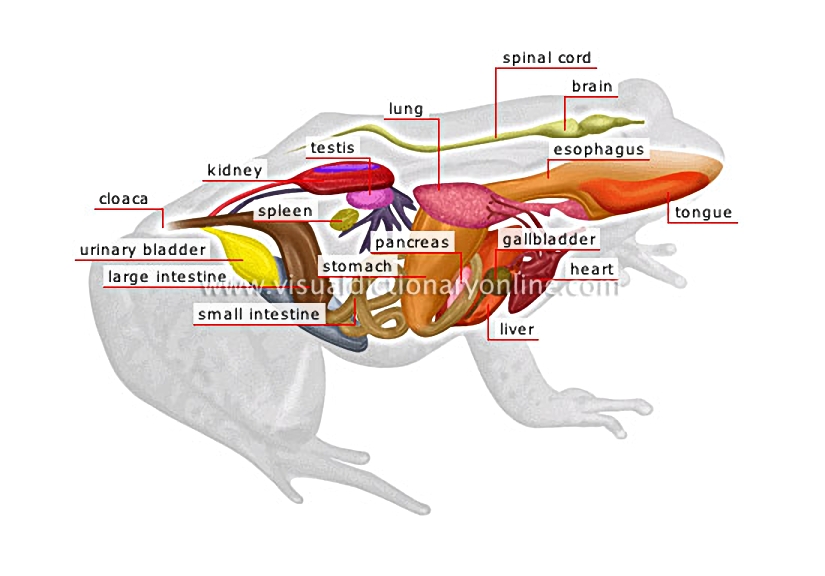
anatomy of a male frog

anatomy of a male frog 						Component of the nervous system made up of a soft fatty substance and forming a cylindrical stem inside the vertebral column.				  							Muscular organ helping blood to circulate.				  							Small reservoir in which bile secreted by the liver collects before being discharged into the intestine during digestion.				  							Gland secreting mostly a substance (bile) that contributes to digestion.				  							Digestive gland connected to the intestine that produces secretions and hormones.				  							Dilated section of the digestive tract preceding the intestine; it receives food to be digested.				  							Long thin portion of the digestive tract behind the stomach in which most of the digestion and food absorption take place.				  							Short wide portion of the digestive tract preceding the cloaca in which a small part of digestion and elimination of waste take place.				  							Reservoir where urine from the kidneys collects before being evacuated by the cloaca.				  							Orifice common to the intestine and the genital and urinary tracts; it is located at the terminal end of the digestive tract.				  							Organ of the circulatory system where impurities in the blood are destroyed.				  							Organ secreting urine; it eliminates toxic substances from the body.				  							Male genital gland producing spermatozoa (sperm).				  							Respiratory organ made of an extensible tissue; it forms a sac into which air inhaled through the nostrils is carried. A frog also breathes through its skin.				  							Main organ of the nervous system consisting of nerve centers; it is located in the upper portion of the head.				  							Canal of the anterior portion of the digestive tract; it carries food to the stomach.				  							Movable mouthpart having gustatory and prehensile functions.

See Also


examples of amphibians?[1]

spinal cord

Component of the nervous system made up of a soft fatty substance and forming a cylindrical stem inside the vertebral column.

heart

Muscular organ helping blood to circulate.

gallbladder

Small reservoir in which bile secreted by the liver collects before being discharged into the intestine during digestion.

liver

Gland secreting mostly a substance (bile) that contributes to digestion.

pancreas

Digestive gland connected to the intestine that produces secretions and hormones.

stomach

Dilated section of the digestive tract preceding the intestine; it receives food to be digested.

small intestine

Long thin portion of the digestive tract behind the stomach in which most of the digestion and food absorption take place.

large intestine

Short wide portion of the digestive tract preceding the cloaca in which a small part of digestion and elimination of waste take place.

urinary bladder

Reservoir where urine from the kidneys collects before being evacuated by the cloaca.

cloaca

Orifice common to the intestine and the genital and urinary tracts; it is located at the terminal end of the digestive tract.

spleen

Organ of the circulatory system where impurities in the blood are destroyed.

kidney

Organ secreting urine; it eliminates toxic substances from the body.

testis

Male genital gland producing spermatozoa (sperm).

lung

Respiratory organ made of an extensible tissue; it forms a sac into which air inhaled through the nostrils is carried. A frog also breathes through its skin.

brain

Main organ of the nervous system consisting of nerve centers; it is located in the upper portion of the head.

esophagus

Canal of the anterior portion of the digestive tract; it carries food to the stomach.
tongue

Movable mouthpart having gustatory and prehensile functions.