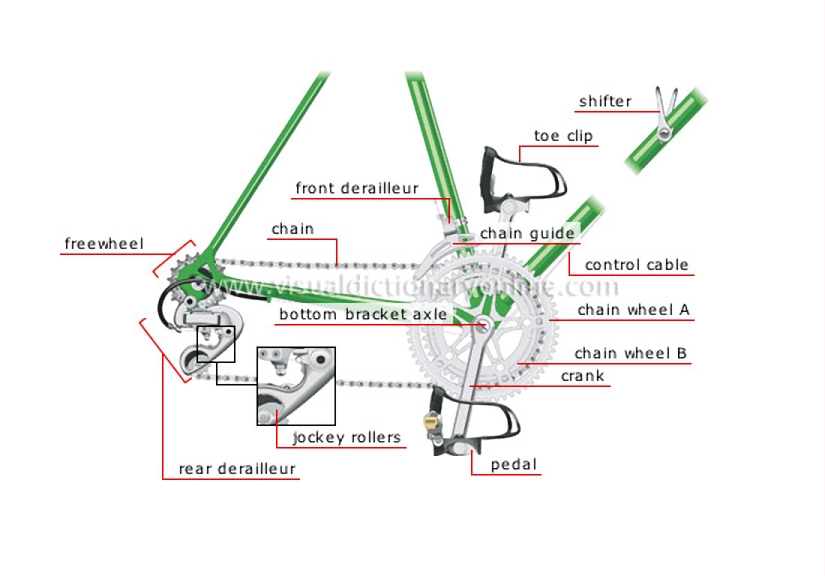
power train
Set of parts (axle, chain wheel, cranks and pedals) transmitting the force exerted by the cyclist on the pedals to the rear wheel.
rear derailleur
Mechanism for changing the rear gears by lifting the chain from one gear wheel to another; it allows the cyclist to adapt to road conditions.
front derailleur
Mechanism for changing the front gears by lifting the chain from one chain wheel to another; it allows the cyclist to adapt to road conditions.
chain
Set of metal links meshing with the sprockets on the chain wheel and gear wheel to transmit the pedaling motion to the rear wheel.
pedal
Part attached to a crank that the cyclist rotates to provide the bicycle’s power.
crank
Metal part bent at a right angle, supporting a pedal and providing a rotational movement around the pedal’s axle.
chain wheel B
Smaller wheel with sprockets that, in combination with the rear gear wheels, decreases the distance of one rotation of the pedal.
bottom bracket axle
Tube to which the crank is attached at each end so that one end is up when the other is down.
chain wheel A
Larger wheel with sprockets that, in combination with the rear gear wheels, increases the distance of one rotation of the pedal, and therefore the speed of the bicycle.
control cable
Wire made of steel strands transmitting the action exerted on the shifter to each derailleur.
freewheel
Mechanism attached to the rear-wheel hub allowing it to continue turning when the cyclist stops pedaling.
chain guide
Part of the derailleur moving the chain from one chain wheel to the other.
toe clip
Metal device attached to the pedals that covers the front of the feet, keeping the feet in the proper position and increasing pedaling power.
jockey rollers
Small wheels guiding the chain and keeping it taut while changing gears.
 previous