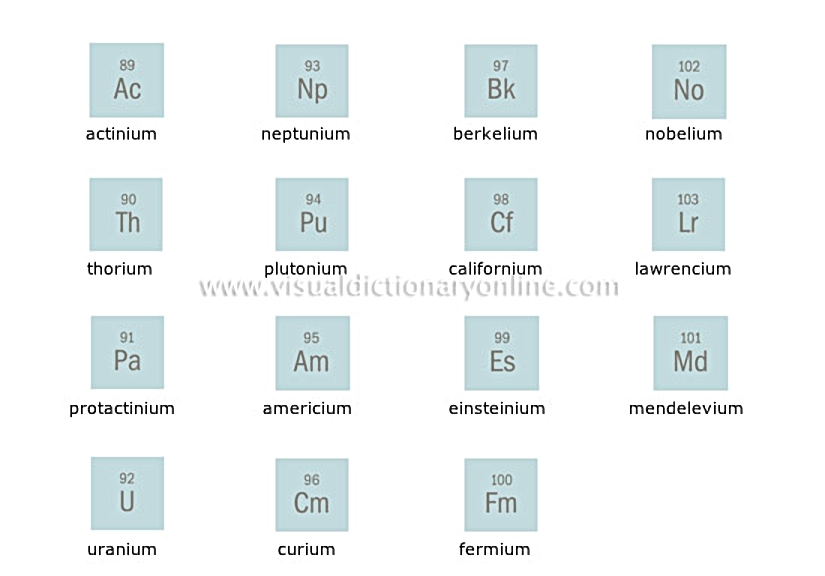
actinides
Radioactive elements that are abundant in nature (elements 89 to 92) or made artificially (elements 93 to 103). Most of them have no industrial applications.
lawrencium
Metal that is produced from californium; it is used for scientific research only.
nobelium
Metal that is produced from curium; it is named in honor of Alfred Nobel (inventor of dynamite and founder of the Nobel Prize).
mendelevium
Metal that is produced from einsteinium; it is named in honor of the chemist Mendeleyev (who classified the elements).
fermium
Metal that was discovered at the same time as einsteinium; it is used for scientific research only.
einsteinium
Metal that was discovered in 1952 among the debris of the first thermonuclear explosion in the Pacific; it is used for scientific research only.
californium
Metal produced from curium that is used especially in the treatment of cancer and in some measuring instruments such as humidistats.
berkelium
Metal that is produced in small amounts from americium; it is used for scientific research only.
curium
Metal that is produced in small amounts from plutonium; it is used especially in thermoelectric generators for spacecraft propulsion.
americium
Metal that is produced from plutonium; it is used mainly in smoke detectors and in radiology.
plutonium
Metal that is produced from uranium; it is used especially as fuel in nuclear reactors as well as in nuclear weapons.
neptunium
Rare metal that is produced from uranium; it is used in neutron-detection instruments.
uranium
Naturally abundant metal that is used mainly as fuel in nuclear reactors as well as in nuclear weapons.
protactinium
Very rare metal that is present in uranium ore; it has few applications outside of scientific research.
thorium
Natural metal that is used especially in alloys, photoelectric cells and uranium production.
actinium
Metal that is present in small quantities in uranium ore; it is used mainly as a source of neutrons in nuclear reactors.
 previous
