plant cell

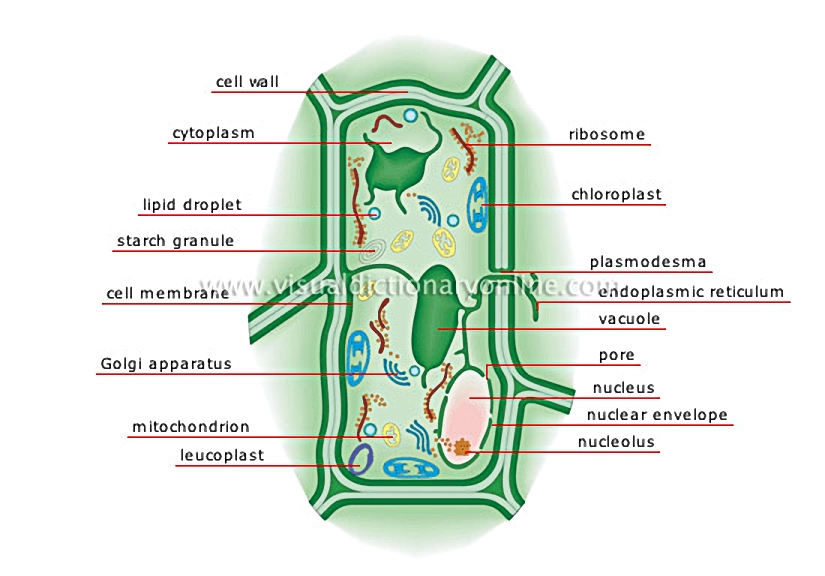
Smallest living structure and the constituent element of all vegetables; it varies in size and shape depending on its function.
plant cell 						Small colorless structure that produces and stores starch, the vegetable’s food.				  							Ovoid organelle that produces the energy necessary for cell activity.				  							Organelle composed of a series of pockets that receive proteins produced by the ribosomes and either transport them outside the cell or to other organelles.				  							Spherical cavity containing water, waste and various substances required by the cell.				  							Casing that covers the cell’s cytoplasm; it acts as a filter, controlling the passage of certain substances in and out of the cell.				  							Concentric layers of starch produced by the cell and stored for food.				  							Small sac filled with essential fatty acids that are produced by the cell and stored for food.				  							Clear gelatinous substance surrounding the various cellular structures.				  							Small spherical body located inside the nucleus, within which the ribosomes, or protein-synthesizing structures, are produced.				  							A double-layered membrane enveloping the nucleus.				  							Organelle containing a cell’s genes and controlling its activities.				  							Perforations in the nuclear envelope allowing for exchanges between the cytoplasm and the nucleus.				  							Interconnecting tubes allowing substances to be transported within the cell or between the cell and its exterior environment.				  							Perforations in the membranes allowing two adjacent cells to exchange cytoplasm.				  							Small structure, containing a green pigment called chlorophyll, which absorbs solar energy and uses it to produce glucose, the vegetable’s food.				  							Small structure, occasionally attached to the endoplasmic reticulum; it generates proteins essential to the formation and functioning of living things.				  							Stiff exterior surface of the cytoplasmic membrane that gives the cell its shape.
See Also


structure of a plant

animal cell

leucoplast

Small colorless structure that produces and stores starch, the vegetable’s food.

mitochondrion

Ovoid organelle that produces the energy necessary for cell activity.

Golgi apparatus

Organelle composed of a series of pockets that receive proteins produced by the ribosomes and either transport them outside the cell or to other organelles.

vacuole

Spherical cavity containing water, waste and various substances required by the cell.

cell membrane

Casing that covers the cell’s cytoplasm; it acts as a filter, controlling the passage of certain substances in and out of the cell.

starch granule

Concentric layers of starch produced by the cell and stored for food.

lipid droplet

Small sac filled with essential fatty acids that are produced by the cell and stored for food.

cytoplasm

Clear gelatinous substance surrounding the various cellular structures.

nucleolus

Small spherical body located inside the nucleus, within which the ribosomes, or protein-synthesizing structures, are produced.

nuclear envelope

A double-layered membrane enveloping the nucleus.

nucleus

Organelle containing a cell’s genes and controlling its activities.

pore

Perforations in the nuclear envelope allowing for exchanges between the cytoplasm and the nucleus.

endoplasmic reticulum

Interconnecting tubes allowing substances to be transported within the cell or between the cell and its exterior environment.

plasmodesma

Perforations in the membranes allowing two adjacent cells to exchange cytoplasm.

chloroplast

Small structure, containing a green pigment called chlorophyll, which absorbs solar energy and uses it to produce glucose, the vegetable’s food.

ribosome

Small structure, occasionally attached to the endoplasmic reticulum; it generates proteins essential to the formation and functioning of living things.

cell wall

Stiff exterior surface of the cytoplasmic membrane that gives the cell its shape.