taste receptors

The mucous membrane of the tongue is composed of small protuberances, lingual taste buds, distinguished by their particular sensitivity to one of the basic flavors: sweet, salty, sour, bitter.
taste receptors 						Saliva-filled depression delimiting the lingual taste buds.				  							Each of the three pairs of saliva-secreting organs responsible for moistening food so that the taste buds can perceive its taste.				  							Organ of taste formed of sensory cells that, in contact with saliva, detect flavors and transmit them to the brain in the form of nerve impulses.				  							Taste bud located mainly on the posterior lateral edges of the tongue and having a taste function; it is most sensitive to sour flavors.				  							Mushroom-shaped taste bud occurring in large numbers at the apex and on the sides of the tongue and having a taste function; it reacts mainly to sweet and salty flavors.				  							Each of the large taste buds (about 10) forming a lingual V at the back of the body of the tongue ensuring the taste function; they mostly perceive bitter flavors.				  							Cone-shaped taste bud covering the rear of the tongue; its function is solely tactile. These taste buds give the tongue its velvety appearance.

See Also


dorsum of tongue

furrow

Saliva-filled depression delimiting the lingual taste buds.

salivary gland

Each of the three pairs of saliva-secreting organs responsible for moistening food so that the taste buds can perceive its taste.

taste bud

Organ of taste formed of sensory cells that, in contact with saliva, detect flavors and transmit them to the brain in the form of nerve impulses.

foliate papilla

Taste bud located mainly on the posterior lateral edges of the tongue and having a taste function; it is most sensitive to sour flavors.

fungiform papilla

Mushroom-shaped taste bud occurring in large numbers at the apex and on the sides of the tongue and having a taste function; it reacts mainly to sweet and salty flavors.

circumvallate papilla

Each of the large taste buds (about 10) forming a lingual V at the back of the body of the tongue ensuring the taste function; they mostly perceive bitter flavors.
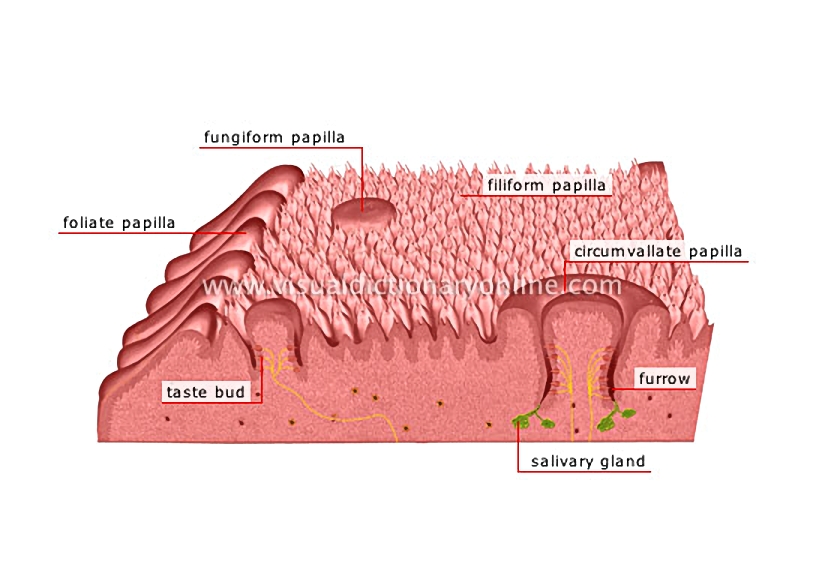
filiform papilla

Cone-shaped taste bud covering the rear of the tongue; its function is solely tactile. These taste buds give the tongue its velvety appearance.