structure of the spinal cord

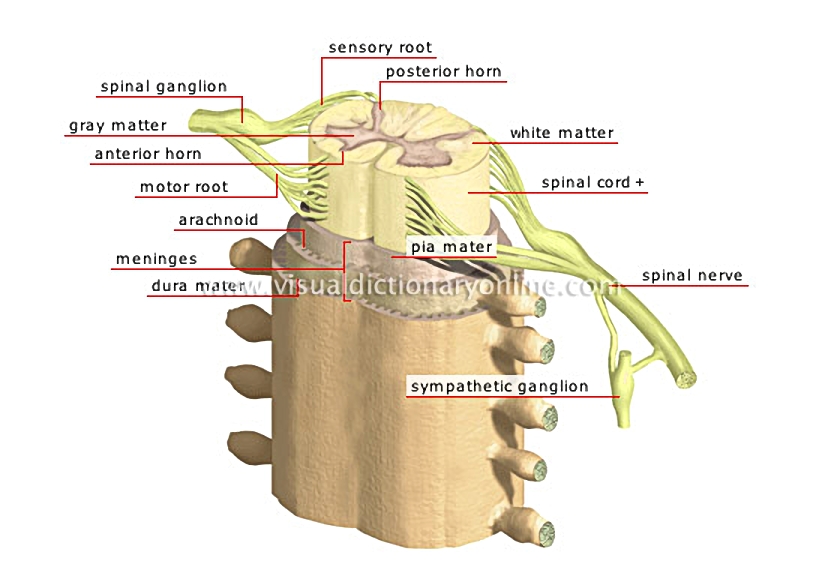
The spinal cord, protected by several solid and liquid membranes, is the source of 31 pairs of spinal nerves; it connects them to the brain.
structure of the spinal cord 						Bulge made up of nerve cell bodies forming a chain on both sides of the spinal cord; it mainly controls contraction of the visceral muscles.				  							Thin and highly veined inner meninx directly covering the spinal cord and the roots of the spinal nerves.				  							Part of the central nervous system located in the spinal column; it receives and transmits nerve information and releases the reflexes.												Nerve formed by the union of the sensory and motor roots; it communicates nerve messages between the spinal cord and the various parts of the organism.				  							Each of three fibrous membranes surrounding and protecting the central nervous system (spinal cord, brain).				  							Thick and resistant outer meninx fusing with the tissue covering the spinal nerves; it does not adhere directly to the bony vertebral wall.				  							Section of the spinal cord made up of nerve fibers (axons) and surrounding the gray matter.				  							Meninx located between the dura mater and the pia mater.				  							Each of the terminal parts of two masses of gray matter enclosing the cell bodies of motor neurons and from which the motor root originates.				  							Central part of the spinal cord primarily made of the cell bodies of neurons.				  							Each of the terminal parts of the two masses of gray matter enclosing the associative neurons through which the sensory root enters the spinal cord.				  							Bulge of the posterior sensory root of the spinal nerve; it encloses the cell bodies of the neuron sensors.				  							Bundle of sensory nerve fibers (axons) communicating information from the periphery of the body to the spinal cord.				  							Bundle of motor nerve fibers (axons) communicating information from the spinal cord to the periphery of the body, especially the muscles.

See Also


lumbar vertebra

sensory impulse

sympathetic ganglion

Bulge made up of nerve cell bodies forming a chain on both sides of the spinal cord; it mainly controls contraction of the visceral muscles.

pia mater

Thin and highly veined inner meninx directly covering the spinal cord and the roots of the spinal nerves.

spinal cord

Part of the central nervous system located in the spinal column; it receives and transmits nerve information and releases the reflexes.
lumbar vertebra
lumbar vertebra

spinal nerve

Nerve formed by the union of the sensory and motor roots; it communicates nerve messages between the spinal cord and the various parts of the organism.

meninges

Each of three fibrous membranes surrounding and protecting the central nervous system (spinal cord, brain).

dura mater

Thick and resistant outer meninx fusing with the tissue covering the spinal nerves; it does not adhere directly to the bony vertebral wall.

white matter

Section of the spinal cord made up of nerve fibers (axons) and surrounding the gray matter.

arachnoid

Meninx located between the dura mater and the pia mater.

anterior horn

Each of the terminal parts of two masses of gray matter enclosing the cell bodies of motor neurons and from which the motor root originates.

gray matter

Central part of the spinal cord primarily made of the cell bodies of neurons.

posterior horn

Each of the terminal parts of the two masses of gray matter enclosing the associative neurons through which the sensory root enters the spinal cord.

spinal ganglion

Bulge of the posterior sensory root of the spinal nerve; it encloses the cell bodies of the neuron sensors.

sensory root

Bundle of sensory nerve fibers (axons) communicating information from the periphery of the body to the spinal cord.

motor root

Bundle of motor nerve fibers (axons) communicating information from the spinal cord to the periphery of the body, especially the muscles.