lumbar vertebra

Large bony part of the back located between the dorsal vertebrae and the sacrum; it supports a major portion of the body’s weight.
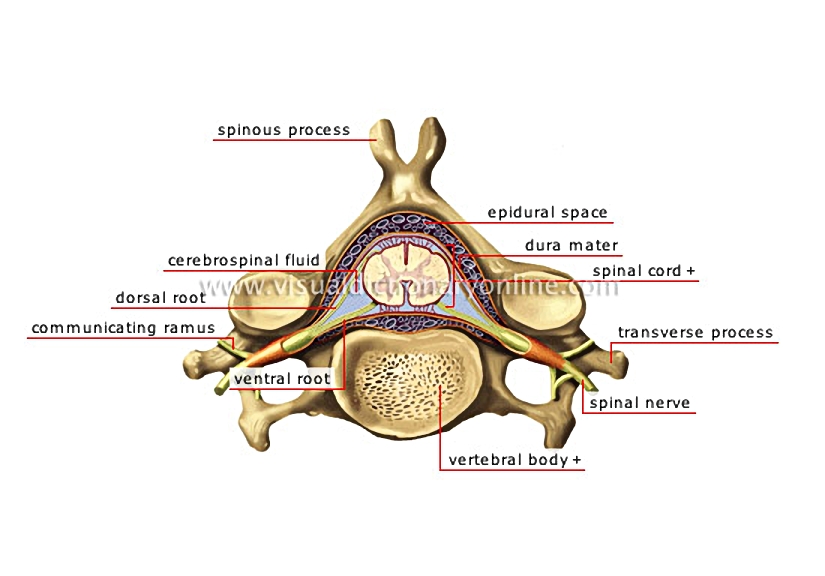
lumbar vertebra 						Branch of the spinal nerve connecting the ganglions of the sympathetic trunk to the spinal cord.				  							Space filled with blood vessels and adipose tissue; separates the dura mater from the vertebra and has a protective function.				  							Fluid contained between the arachnoid and the pia mater around the spinal cord and serving mainly as a shock absorber; it protects the entire central nervous system.				  							Thick and resistant outer meninx fusing with the tissue covering the spinal nerves; it does not adhere directly to the bony vertebral wall.				  							Posterior middle protuberance of the vertebra; the attachment point for the back muscles.				  							Part of the central nervous system located in the spinal column; it receives and transmits nerve information and initiates reflex actions.												Anterior bony cylinder of a vertebra surrounded by two transverse processes.												Nerve formed by the union of the sensory and motor roots; it communicates nerve messages between the spinal cord and the various parts of the organism.				  							Bony protuberance extending laterally from each side of the vertebra; the muscles are attached to it.				  							Bundle of motor nerve fibers (axons) communicating information from the spinal cord to the periphery of the body, especially the muscles.				  							Bundle of sensitive nerve fibers that carry the spinal ganglions and communicate information from the body’s periphery to the spinal cord.

See Also


structure of the spinal cord

spinal column

sensory impulse

central nervous system?[1]

communicating ramus

Branch of the spinal nerve connecting the ganglions of the sympathetic trunk to the spinal cord.

epidural space

Space filled with blood vessels and adipose tissue; separates the dura mater from the vertebra and has a protective function.

cerebrospinal fluid

Fluid contained between the arachnoid and the pia mater around the spinal cord and serving mainly as a shock absorber; it protects the entire central nervous system.

dura mater

Thick and resistant outer meninx fusing with the tissue covering the spinal nerves; it does not adhere directly to the bony vertebral wall.

spinous process

Posterior middle protuberance of the vertebra; the attachment point for the back muscles.

spinal cord

Part of the central nervous system located in the spinal column; it receives and transmits nerve information and initiates reflex actions.
structure of the spinal cord

vertebral body

Anterior bony cylinder of a vertebra surrounded by two transverse processes.
spinal column
spinal column

spinal nerve

Nerve formed by the union of the sensory and motor roots; it communicates nerve messages between the spinal cord and the various parts of the organism.

transverse process

Bony protuberance extending laterally from each side of the vertebra; the muscles are attached to it.

ventral root

Bundle of motor nerve fibers (axons) communicating information from the spinal cord to the periphery of the body, especially the muscles.

dorsal root

Bundle of sensitive nerve fibers that carry the spinal ganglions and communicate information from the body’s periphery to the spinal cord.