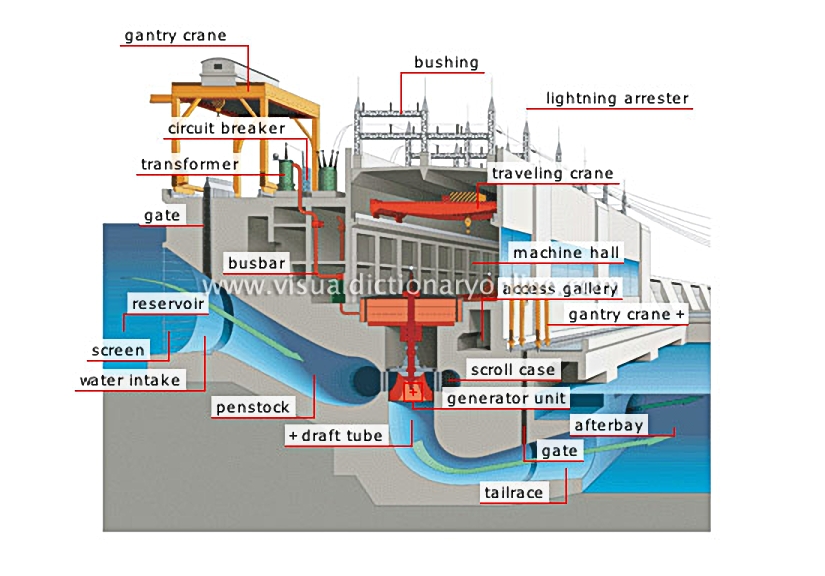
cross section of a hydroelectric power plant

Hydroelectric power plant: plant that produces electricity from energy generated by flowing water.
cross section of a hydroelectric power plant 						Assembly of bars placed in front of the water intake to hold back anything that could hinder the operation of the turbine.				  							Basin formed by the construction of a dam; it holds back a very large volume of water so that the flow rate can be controlled.				  							Structure that directs water from the headbay to the penstock to power the plant.				  							Channel that carries water under pressure to the power plant’s turbines.				  							Large aluminum conductor that transmits electric current from the alternator to the transformer.				  							Conduit at the base of the turbine that increases the runner’s output by reducing the pressure of the water as it exits.												Device with a turbine that transmits the water’s mechanical energy to the generator’s rotor to make it turn to produce electricity.												Channel that discharges water toward the afterbay in order to return it to the watercourse.				  							Area of the watercourse where water is discharged after passing through the turbines.				  							Movable vertical panel that controls the discharge of water to the tailrace.				  							Duct shaped like a spiral staircase that is used to distribute water uniformly around the turbine to make it turn smoothly.				  							Hoisting device in the form of a bridge; it moves along rails.				  							Underground passageway that provides access to various parts of the dam so that it can be inspected and maintained.				  							Area that houses the generator units used to produce electricity.				  							Hoisting device that travels along aboveground parallel rails; it is used to lift and carry heavy loads.				  							Device that protects the electric facilities from power surges caused by lightning.				  							Device that allows the conductor to pass through the wall of the transformer and separates it from the latter.				  							Mechanism automatically cutting off the power supply in the event of overload.				  							Device used to alter the electric voltage; voltage is increased as the current leaves the power plant so that it can be carried over long distances.				  							Hoisting device in the form of a bridge; it moves along rails.				  							Movable vertical panel that controls the volume of water in the penstock.
See Also


generator unit

screen

Assembly of bars placed in front of the water intake to hold back anything that could hinder the operation of the turbine.

reservoir

Basin formed by the construction of a dam; it holds back a very large volume of water so that the flow rate can be controlled.

water intake

Structure that directs water from the headbay to the penstock to power the plant.

penstock

Channel that carries water under pressure to the power plant’s turbines.

busbar

Large aluminum conductor that transmits electric current from the alternator to the transformer.

draft tube

Conduit at the base of the turbine that increases the runner’s output by reducing the pressure of the water as it exits.
generator unit
generator unit

generator unit

Device with a turbine that transmits the water’s mechanical energy to the generator’s rotor to make it turn to produce electricity.
generator unit
generator unit

tailrace

Channel that discharges water toward the afterbay in order to return it to the watercourse.

afterbay

Area of the watercourse where water is discharged after passing through the turbines.

gate

Movable vertical panel that controls the discharge of water to the tailrace.

scroll case

Duct shaped like a spiral staircase that is used to distribute water uniformly around the turbine to make it turn smoothly.

gantry crane

Hoisting device in the form of a bridge; it moves along rails.

access gallery

Underground passageway that provides access to various parts of the dam so that it can be inspected and maintained.

machine hall

Area that houses the generator units used to produce electricity.

traveling crane

Hoisting device that travels along aboveground parallel rails; it is used to lift and carry heavy loads.

lightning arrester

Device that protects the electric facilities from power surges caused by lightning.

bushing

Device that allows the conductor to pass through the wall of the transformer and separates it from the latter.

circuit breaker

Mechanism automatically cutting off the power supply in the event of overload.

transformer

Device used to alter the electric voltage; voltage is increased as the current leaves the power plant so that it can be carried over long distances.

gantry crane

Hoisting device in the form of a bridge; it moves along rails.

gate

Movable vertical panel that controls the volume of water in the penstock.