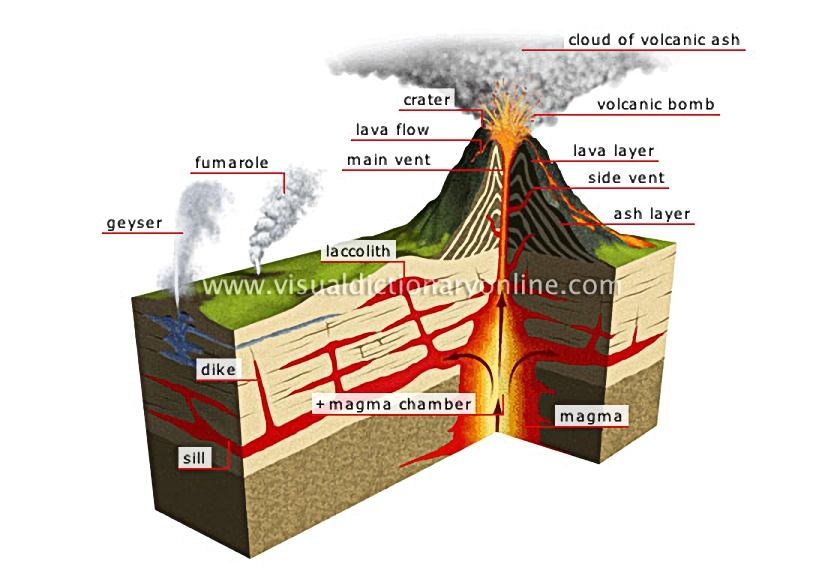
volcano during eruption

Eruption of magmatic matter (molten rock, ash, gas) from the upper mantle; it can last several years.
volcano during eruption 						Ash and lava form the layers that shape the volcano over time.				  							Hot water spring that ejects sporadic jets of water and vapor.				  							Lava mass pouring from a volcano at average speeds of 980 feet per hour; it can reach temperatures as high as 2,200°F.				  							Regular emission of gas from a fissure on the Earth’s surface.				  							Layer of magma that has solidified between the layers of the Earth’s crust; it is about 30 feet thick and several miles long.				  							Mass of magma that enters the Earth’s crust and then solidifies in the form of bladelike shafts that are vertical or oblique to the layers of the Earth.				  							Molten rock and gas under very high pressure that can reach extremely high temperatures.				  							Pocket where magma accumulates before rising to the surface.												Mass of magma that enters the Earth’s crust and then solidifies, causing a deformation on the Earth’s surface.				  							Layer of volcanic rock formed by cooled lava.				  							Small rise that appears on the side of the volcano and is fed by the main vent.				  							Conduit along which lava and other volcanic ejecta rise.				  							Mass of magma ejected high into the air where it solidifies; it can be very large.				  							Ash is formed of particles less than 0.08 in in diameter; it is composed of pulverized magma and ground rock.				  							Depression whose center features a chimney through which lava, gas and volcanic ejecta escape.

See Also


section of the Earths crust

structure of the Earth

ash layer

Ash and lava form the layers that shape the volcano over time.

geyser

Hot water spring that ejects sporadic jets of water and vapor.

lava flow

Lava mass pouring from a volcano at average speeds of 980 feet per hour; it can reach temperatures as high as 2,200°F.

fumarole

Regular emission of gas from a fissure on the Earth’s surface.

sill

Layer of magma that has solidified between the layers of the Earth’s crust; it is about 30 feet thick and several miles long.

dike

Mass of magma that enters the Earth’s crust and then solidifies in the form of bladelike shafts that are vertical or oblique to the layers of the Earth.

magma

Molten rock and gas under very high pressure that can reach extremely high temperatures.

magma chamber

Pocket where magma accumulates before rising to the surface.
section of the Earth’s crust
structure of the Earth

laccolith

Mass of magma that enters the Earth’s crust and then solidifies, causing a deformation on the Earth’s surface.

lava layer

Layer of volcanic rock formed by cooled lava.

side vent

Small rise that appears on the side of the volcano and is fed by the main vent.

main vent

Conduit along which lava and other volcanic ejecta rise.

volcanic bomb

Mass of magma ejected high into the air where it solidifies; it can be very large.

cloud of volcanic ash

Ash is formed of particles less than 0.08 in in diameter; it is composed of pulverized magma and ground rock.

crater

Depression whose center features a chimney through which lava, gas and volcanic ejecta escape.