Vauban fortification
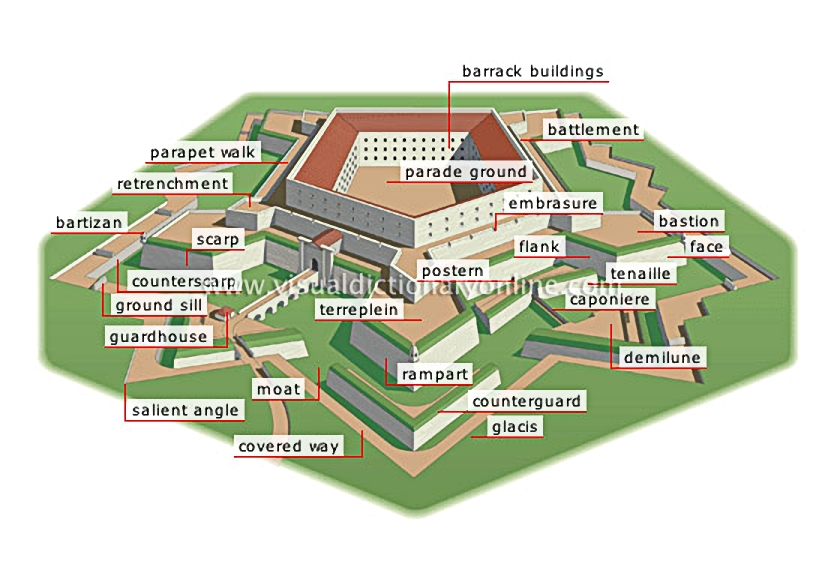
Star-shaped military fortification developed by the Frenchman Vauban in the 17th century.
barrack buildings
Buildings used as living and instructional quarters for the garrison.
battlement
Wall allowing defenders of the fortification to fire from a protected position.
bastion
A fortified projection consisting of two faces and two flanks, designed to reinforce a stronghold.
flank
Part of the bastion between the curtain wall and the face, making it possible to fire parallel to the face of the neighboring bastion.
tenaille
Fortification made up of two faces forming an angle opening inward, placed in front of the curtain wall and designed to shield it.
demilune
Freestanding triangular fortification placed in front of a curtain wall and having a firing surface.
caponiere
Path dug through the moat to provide access to freestanding fortifications such as the demilune.
terreplein
Horizontal surface of a bastion designed to accommodate the artillery.
counterguard
Freestanding fortification that protected the faces of the bastion and allowed the artillery to dominate the glacis.
glacis
Sloping terrain surrounding a fortification to conceal the covered ways and the counterscarp.
covered way
Walkway built along the counterscarp and protected by the height of the glacis.
salient angle
Projecting angle of the fortification, protecting the covered way.
ground sill
Fortification of earth or masonry perpendicular to the covered way and specially designed to protect the defenders against ricochets.
bartizan
A sentry box projecting from a wall used to survey the surrounding area.
retrenchment
Raised fortification of a bastion allowing the artillery to dominate the terrain.
parapet walk
Passageway along a wall, making it possible to shoot and perform surveillance.
 previous