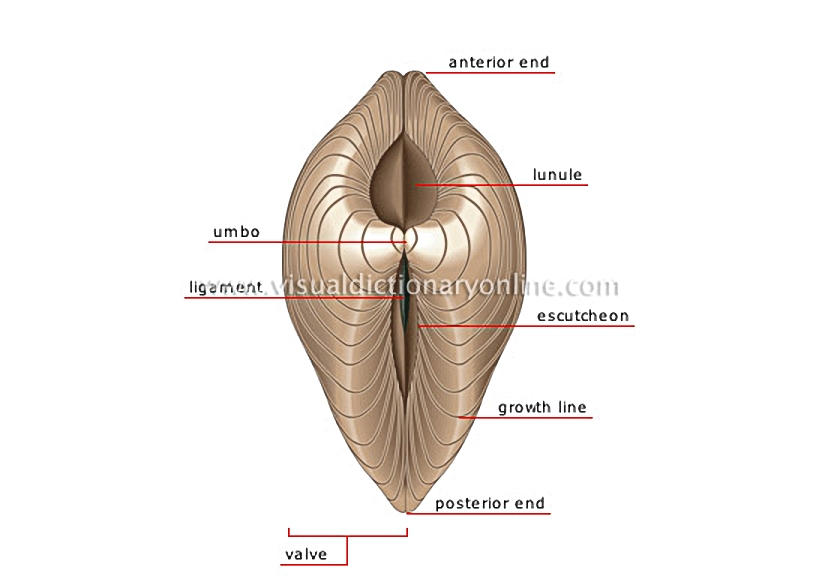
morphology of a bivalve shell

morphology of a bivalve shell 						Each of the two parts of a bivalve shell, joined by a ligament.				  							Rear terminal end of the shell, opposite the anterior lip, through which water enters and exits.				  							Small irregular protuberance on the valves of the shell indicating the stages of growth.				  							Dorsal depression of the two valves behind the umbones, through which the ligament extends; its surface is smooth, unlike the rest of the shell.				  							Corneous structure located behind the umbones and joining both valves of the shell; its elasticity allows them to pull apart.				  							Protuberance at the terminal end of the valve, from which the shell grows.				  							Dorsal depression of the two valves in front of the umbones; its surface is smooth, unlike the rest of the shell.				  							Front terminal end of the shell located opposite the posterior lip; it allows the foot to exit.

See Also


flat oyster

abalone

scallop

great scallop

clam

cockle

razor clam

soft-shell clam

hard-shell clam

blue mussel

cupped Pacific oyster

valve

Each of the two parts of a bivalve shell, joined by a ligament.

posterior end

Rear terminal end of the shell, opposite the anterior lip, through which water enters and exits.

growth line

Small irregular protuberance on the valves of the shell indicating the stages of growth.

escutcheon

Dorsal depression of the two valves behind the umbones, through which the ligament extends; its surface is smooth, unlike the rest of the shell.
ligament

Corneous structure located behind the umbones and joining both valves of the shell; its elasticity allows them to pull apart.

umbo

Protuberance at the terminal end of the valve, from which the shell grows.

lunule

Dorsal depression of the two valves in front of the umbones; its surface is smooth, unlike the rest of the shell.

anterior end

Front terminal end of the shell located opposite the posterior lip; it allows the foot to exit.