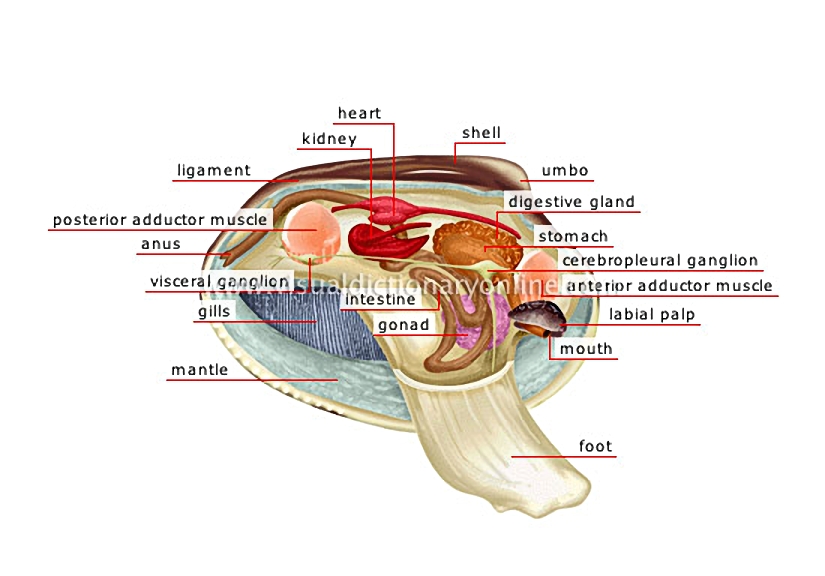
anatomy of a bivalve shell

anatomy of a bivalve shell 						Calcareous casing produced by the mantle; it has three layers and protects the main organs of the mollusk.				  							Corneous structure located behind the umbones and joining both valves of the shell; its elasticity allows them to pull apart.				  							Protuberance at the terminal end of the valve, from which the shell grows.				  							Short flat movable muscular organ located on the ventral surface; it allows the snail to move or to attach itself to a support using elastic filaments.				  							Thick fold of tissue forming two lateral lobes; it envelops the organic mass of the mollusk and secretes its shell.				  							Section of the digestive tract between the stomach and the anus where absorption of nutrients is carried out and waste is transformed into fecal matter.				  							Small sac located near the anterior abductor muscle; the nervous system is made up of three pairs of ganglia (cerebropleural, visceral and pedal).				  							Small sac located near the posterior abductor muscle; the nervous system is made up of three pairs of ganglia (cerebropleural, visceral and pedal).				  							Terminal orifice of the digestive tract enabling ejection of fecal matter.				  							Powerful muscle attached to both inside surfaces of the valves; it contracts to open or close them quickly.				  							Organ secreting urine; it eliminates toxic substances from the body.				  							Muscular organ helping blood to circulate.				  							Organ producing a secretion that contributes to digestion.				  							Dilated section of the digestive tract preceding the intestine; it receives food to be digested.				  							Muscle attached to both inside surfaces of the valves that contracts to open or close them quickly; it is less powerful than the posterior abductor muscle.				  							Mouthpart that grasps food particles deposited on the gills and carries them to the mouth.				  							Anterior cavity of the digestive tract surrounded by four labial palps, which enable food particles to enter.				  							Genital gland producing spermatozoa (sperm) or ova (eggs), depending on the sex of the mollusk.				  							Respiratory organs located between the foot and the mantle, formed of two layers of ciliated filaments, which filter water and retain food particles.

See Also


scallop

great scallop

clam

cockle

razor clam

blue mussel

cupped Pacific oyster

flat oyster

abalone

hard-shell clam

soft-shell clam

shell

Calcareous casing produced by the mantle; it has three layers and protects the main organs of the mollusk.

ligament

Corneous structure located behind the umbones and joining both valves of the shell; its elasticity allows them to pull apart.

umbo

Protuberance at the terminal end of the valve, from which the shell grows.

foot

Short flat movable muscular organ located on the ventral surface; it allows the snail to move or to attach itself to a support using elastic filaments.

mantle

Thick fold of tissue forming two lateral lobes; it envelops the organic mass of the mollusk and secretes its shell.

intestine

Section of the digestive tract between the stomach and the anus where absorption of nutrients is carried out and waste is transformed into fecal matter.

cerebropleural ganglion

Small sac located near the anterior abductor muscle; the nervous system is made up of three pairs of ganglia (cerebropleural, visceral and pedal).

visceral ganglion

Small sac located near the posterior abductor muscle; the nervous system is made up of three pairs of ganglia (cerebropleural, visceral and pedal).

anus

Terminal orifice of the digestive tract enabling ejection of fecal matter.

posterior adductor muscle

Powerful muscle attached to both inside surfaces of the valves; it contracts to open or close them quickly.

kidney

Organ secreting urine; it eliminates toxic substances from the body.

heart

Muscular organ helping blood to circulate.

digestive gland

Organ producing a secretion that contributes to digestion.

stomach

Dilated section of the digestive tract preceding the intestine; it receives food to be digested.

anterior adductor muscle

Muscle attached to both inside surfaces of the valves that contracts to open or close them quickly; it is less powerful than the posterior abductor muscle.

labial palp

Mouthpart that grasps food particles deposited on the gills and carries them to the mouth.

mouth

Anterior cavity of the digestive tract surrounded by four labial palps, which enable food particles to enter.

gonad

Genital gland producing spermatozoa (sperm) or ova (eggs), depending on the sex of the mollusk.

gills

Respiratory organs located between the foot and the mantle, formed of two layers of ciliated filaments, which filter water and retain food particles.