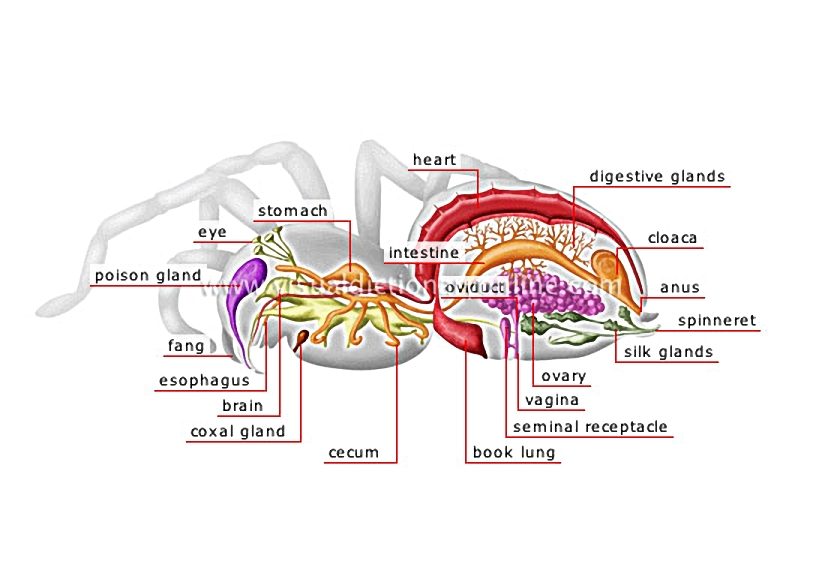
anatomy of a female spider

anatomy of a female spider 						Curved part below the eyes and attached to the venom gland; it allows the spider to catch its prey to inject it with venom.				  							Organ producing an acidic secretion made of venom; it is attached to the fang.				  							Orifice common to the intestine and the genital and urinary tracts; it is located at the terminal end of the digestive tract.				  							Organ of vision joined to the brain by a nerve; the spider usually has four pairs of simple eyes.				  							Dilated section of the digestive tract preceding the intestine; it receives food to be digested.				  							Muscular organ helping blood to circulate.				  							Organs producing a secretion that contributes to digestion.				  							Terminal orifice of the digestive tract enabling ejection of fecal matter.				  							Appendage located near the anus, where the silk glands end; the spider generally has three pairs.				  							Silk-secreting organs located in the abdomen and ending in the spinneret.				  							Canal through which the eggs are expelled from the ovaries.				  							Female organ of copulation located on the ventral face of the abdomen.				  							Female genital gland producing the eggs.				  							Pouch where sperm is stored for fertilizing the eggs.				  							Respiratory organ that helps to oxygenate the blood; the respiratory system has one or two pairs, depending on the type of spider.				  							Section of the digestive tract between the stomach and the anus where nutrients are absorbed and  waste is turned into fecal matter.				  							Lateral canal located in the anterior portion of the intestine where especially a part of digestion and fermentation take place.				  							Main organ of the nervous system; it is located in the cephalothorax.				  							Organ appended to the hip and producing a secretion that contributes to excretion.				  							Canal of the anterior portion of the digestive tract; it carries food to the stomach.
See Also


examples of arachnids

fang

Curved part below the eyes and attached to the venom gland; it allows the spider to catch its prey to inject it with venom.

poison gland

Organ producing an acidic secretion made of venom; it is attached to the fang.

cloaca

Orifice common to the intestine and the genital and urinary tracts; it is located at the terminal end of the digestive tract.

eye

Organ of vision joined to the brain by a nerve; the spider usually has four pairs of simple eyes.

stomach

Dilated section of the digestive tract preceding the intestine; it receives food to be digested.

heart

Muscular organ helping blood to circulate.

digestive glands

Organs producing a secretion that contributes to digestion.

anus

Terminal orifice of the digestive tract enabling ejection of fecal matter.

spinneret

Appendage located near the anus, where the silk glands end; the spider generally has three pairs.

silk glands

Silk-secreting organs located in the abdomen and ending in the spinneret.

oviduct

Canal through which the eggs are expelled from the ovaries.

vagina

Female organ of copulation located on the ventral face of the abdomen.

ovary

Female genital gland producing the eggs.

seminal receptacle

Pouch where sperm is stored for fertilizing the eggs.

book lung

Respiratory organ that helps to oxygenate the blood; the respiratory system has one or two pairs, depending on the type of spider.

intestine

Section of the digestive tract between the stomach and the anus where nutrients are absorbed and waste is turned into fecal matter.

cecum

Lateral canal located in the anterior portion of the intestine where especially a part of digestion and fermentation take place.

brain

Main organ of the nervous system; it is located in the cephalothorax.

coxal gland

Organ appended to the hip and producing a secretion that contributes to excretion.

esophagus

Canal of the anterior portion of the digestive tract; it carries food to the stomach.